Social Listening29 September 20266 min read
Best social listening tools in 2026 (Tried & tested)
 Anil SalviCMO and co-founder, BrandRobin
I spent almost 9 years as a CMO.
If there’s one thing I learned during that time, it’s how important social listening is.
You can have all the dashboards, surveys and reports in the world, but people are already telling you what they think about your brand, product and competitors. You just need to listen.
I’ve used quite a few social listening tools over the years. And while researching them for this comparison, I noticed some pretty big gaps.
Pricing is often unclear. Some tools don’t publish it at all. And very few feel ready for the AI era, where APIs, MCP and deeper integrations matter.
That’s one of the reasons I started building BrandRobin.ai.
I’ve included BrandRobin here too. No special treatment. If something is missing, I’ll say it. If another tool does something better, I’ll say that too.
No hype. Just what I found.
Everything was checked on the vendors’ own websites on 29 September 2026.
The short list
If you only have a minute, this is the whole article in one table. Click a tool to jump to its section.
| Tool | Best for | Pricing, as published | Free trial |
|---|---|---|---|
 BrandRobin BrandRobin | Brand mention tracking and analysis, with real insights on what the market says | Free for 7 days; paid plans coming soon | 7 days, no card |
 Brand24 Brand24 | The broadest self-serve channel list | From $199/mo billed annually, $249 monthly | 14 days, no card |
 Brandwatch Brandwatch | Enterprise consumer research | Not published, demo only | No self-serve trial |
 Talkwalker (Lumen) Talkwalker (Lumen) | Enterprise brand and comms teams | Not published, demo only | No self-serve trial |
 Meltwater Meltwater | PR teams who need news and social together | Not published, 12-month minimum | No self-serve trial |
 Sprout Social Sprout Social | Social teams who already publish in it | $79 a seat; listening add-on not published | 30 days, no card |
 YouScan YouScan | Image-led brands | From $499/mo billed annually | After a demo |
 Mentionlytics Mentionlytics | Review sites alongside social | From $49/mo billed yearly | 14 days, no card |
 Awario Awario | Mention volume on a small budget | From $29/mo billed annually, $49 monthly | 7 days, no card |
 Mention Mention | Mid-size brands and PR teams | Not published, demo | Yes, length not stated |
How I compared them
After almost nine years of buying marketing tools, I judge a social listening tool on five things. They decided every pro and con below.
- Platforms covered. The first thing I check is whether a tool names the places my customers actually talk. "Millions of sources" tells me nothing. A named list of social networks, communities, review sites and news tells me whether it will see the conversations that matter.
- Pricing. I want to know what a tool costs before I talk to sales. In my experience the entry plan is rarely the plan you end up on, so I always look at the second tier: what it costs and what it adds.
- Accuracy. Volume is easy. Relevance is hard. I read a sample of mentions by hand, and if a third of them are about something else that shares the brand's name, the dashboard is wrong before I have opened a single chart.
- Reviews. I trust what other buyers say after six months more than what a demo shows in thirty minutes. Where a con below comes from reviews, it is a theme that keeps coming up, not a one-off complaint.
- AI capabilities. Every tool says it has AI now. What I look for is whether the AI answers with sources I can check, and whether I can get the data out through an API or MCP into the tools and agents my team already uses.
If you want the background on why a mention count on its own is a weak way to compare these tools, I wrote about why mention counts lie.
First, decide which purchase you are making
Most "best social listening tools" lists put Brandwatch and Awario side by side, as if a buyer weighs one against the other. Almost nobody does. They are different purchases, made by different people, with budgets that differ by an order of magnitude.
Enterprise research suites. Brandwatch, Talkwalker, Meltwater. Deep history, dozens of networks including broadcast and regional platforms, analyst-grade query builders. Sold through sales, on annual terms.
Listening inside a social media suite. Sprout Social, and Hootsuite at its Enterprise tier. You buy these because the team already schedules and replies in the tool, and listening is one more tab.
Self-serve listening. BrandRobin, Brand24, YouScan's entry plan, Mentionlytics, Awario and Mention. You can start most of them today, see your own data this week, and cancel if it does not help.
Pick the purchase first. Comparing across them is how teams end up paying enterprise money for a job a $50 tool would have done, or the reverse.
BrandRobin
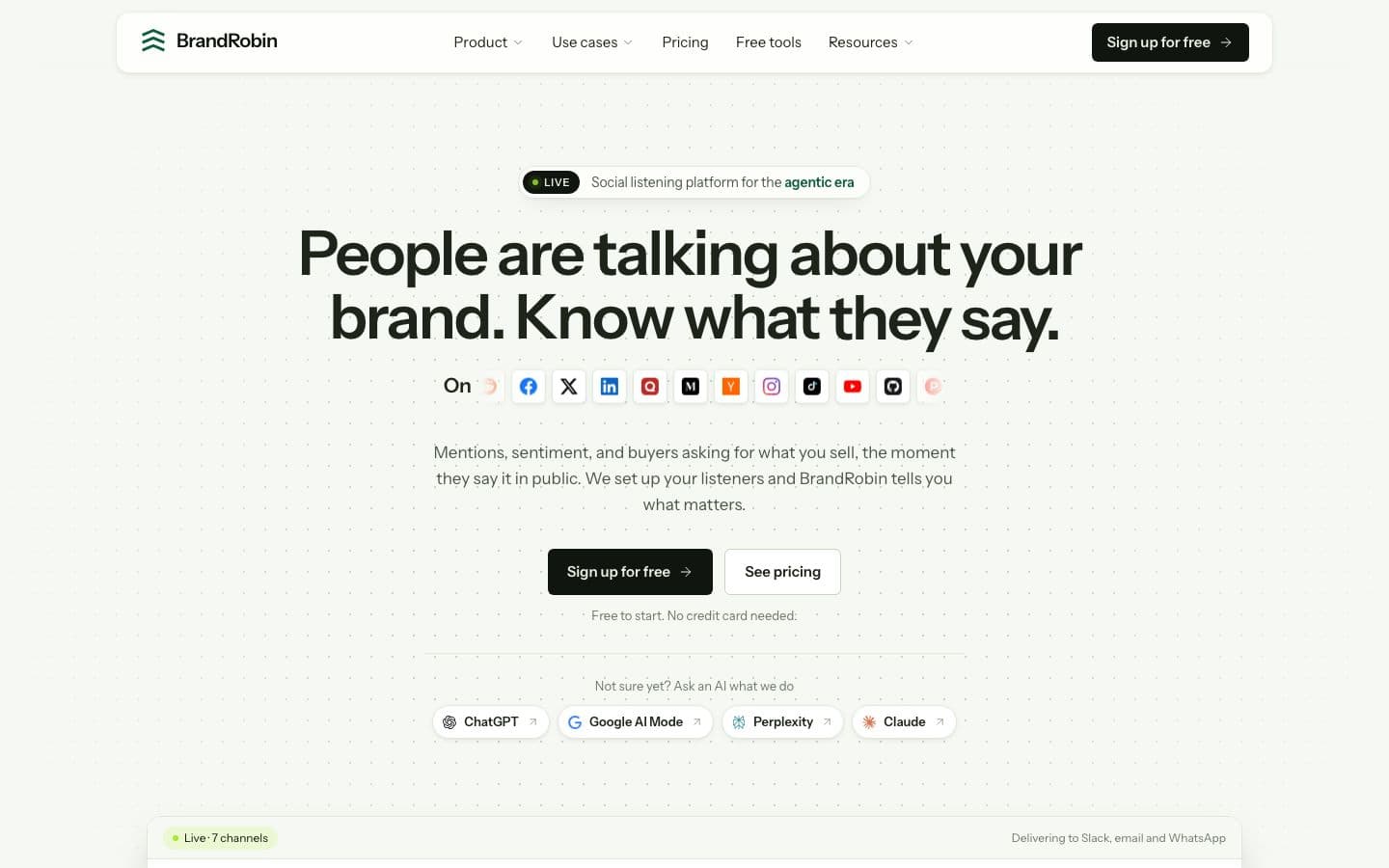
Ours, and first because it is ours. Read this section with that in mind, and hold it to the same standard as the others.
Ours
- Best for
- Teams who want their brand mentions tracked, analysed and turned into real insights on what the market is saying
- Starting price
- Free for the 7-day trial. Paid plans are coming soon
- Free trial
- 7 days, no card
Pros
- Mentions and buyer signals sit in separate feeds, so someone shopping for a product like yours is not buried under someone who simply said your name.
- An AI analyst that answers only from the mentions in your workspace, with a link to every source behind every claim.
- Setup takes about three minutes from your website, and the last 30 days are backfilled on day one, so the first report is not empty.
- Seventeen named channels, including Reddit, X, LinkedIn, YouTube, Quora, reviews, news, blogs and podcasts.
Cons
- Pricing is not published yet, so you cannot budget past the trial today.
- A young product: no licensed broadcast TV, radio or paywalled press.
- No private Slack, Discord or WhatsApp groups.
- The MCP server for AI agents is not live yet.
Why it is on this list: most tools here are built to count mentions and chart them. BrandRobin is built for the question that comes after the chart, which is what to do about it. It separates the person asking for a recommendation from the person who merely mentioned you, and it answers "why did sentiment drop" with the actual posts attached. If that is the job, it belongs on your shortlist next to Brand24. If deep history or broadcast is the job, one of the enterprise suites is the better buy, and I would say so to a friend.
Brand24
- Best for
- Teams that want the broadest named channel list without a sales call
- Starting price
- $199/mo billed annually ($249 monthly). Team $299, Pro $399, Business $599, Enterprise from $1,499
- Free trial
- 14 days, no card
Pros
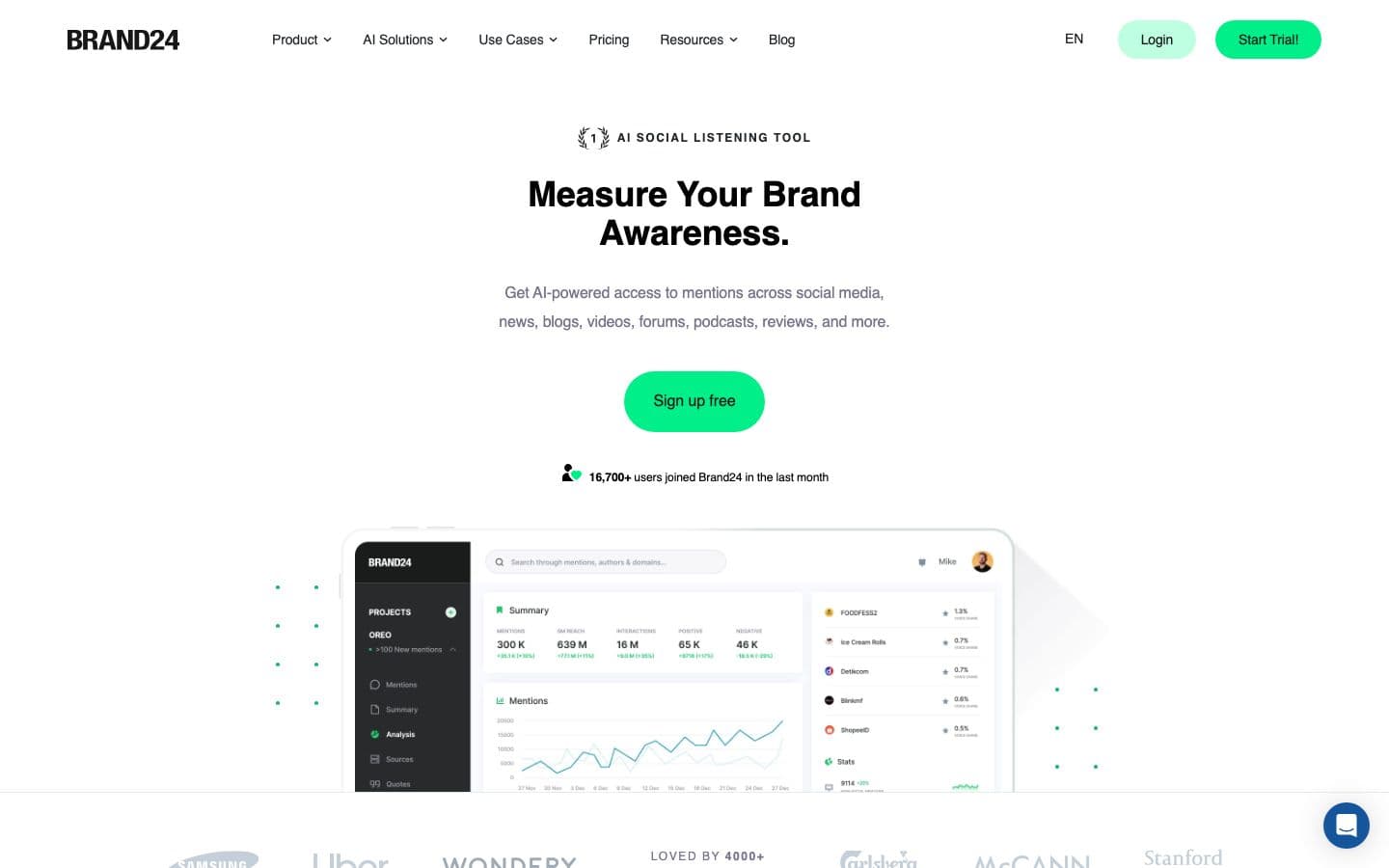
- The broadest named channel list you can buy self-serve: Facebook, Instagram, X, LinkedIn, TikTok, Reddit, YouTube, Twitch, news, blogs, reviews, Medium, Quora, newsletters and podcasts.
- Every price is published, from the entry plan to Business.
- Sentiment analysis on every plan, and white-label reports.
- AI insights, topic analysis and event detection from the Pro plan up.
Cons
- The entry plan is 3 keywords, 2,000 mentions, one user and updates every 12 hours.
- The AI features start at Pro, $399 a month billed annually.
- G2 reviewers mention that tight keyword limits make noise hard to filter when a brand name is not unique.
My take: the channel list is excellent. The entry plan is really a trial with a price on it: most teams will be on Team at $299 a month within a few weeks, so budget for that from the start.
Brandwatch
- Best for
- Enterprise insights and research teams
- Starting price
- Not published. Standard to enterprise plans through a demo
- Free trial
- No self-serve trial, demo only
Pros
- History back to 2008 for social, and 2010 for news, blogs and forums.
- One of the widest network lists anywhere: TikTok, Threads, Bluesky, Reddit, Twitch, WeChat, Weibo, RedNote, reviews, and broadcast TV and radio.
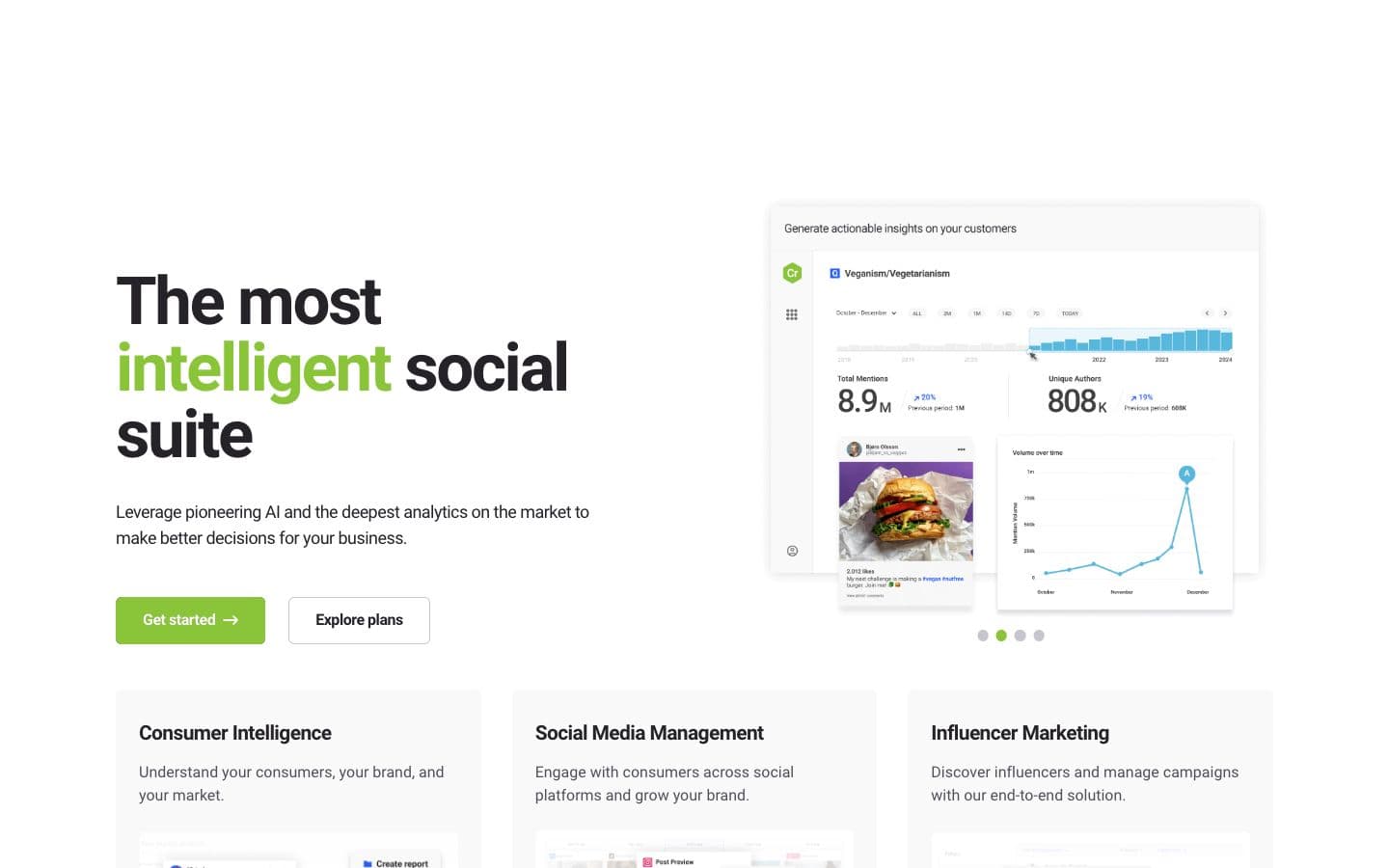
- Image analysis and custom machine-learning classifiers.
- Iris, an AI assistant that turns query results into readable summaries.
Cons
- No public price, so you cannot budget before a sales call.
- No self-serve trial.
- G2 reviewers often mention a steep learning curve and query building that is hard for new users.
My take: if your job is research, meaning "how has the conversation about our category shifted since 2019", nothing else on this list has that depth. If your job is "tell me what people said about us this week", you are paying for a research library to read the news.
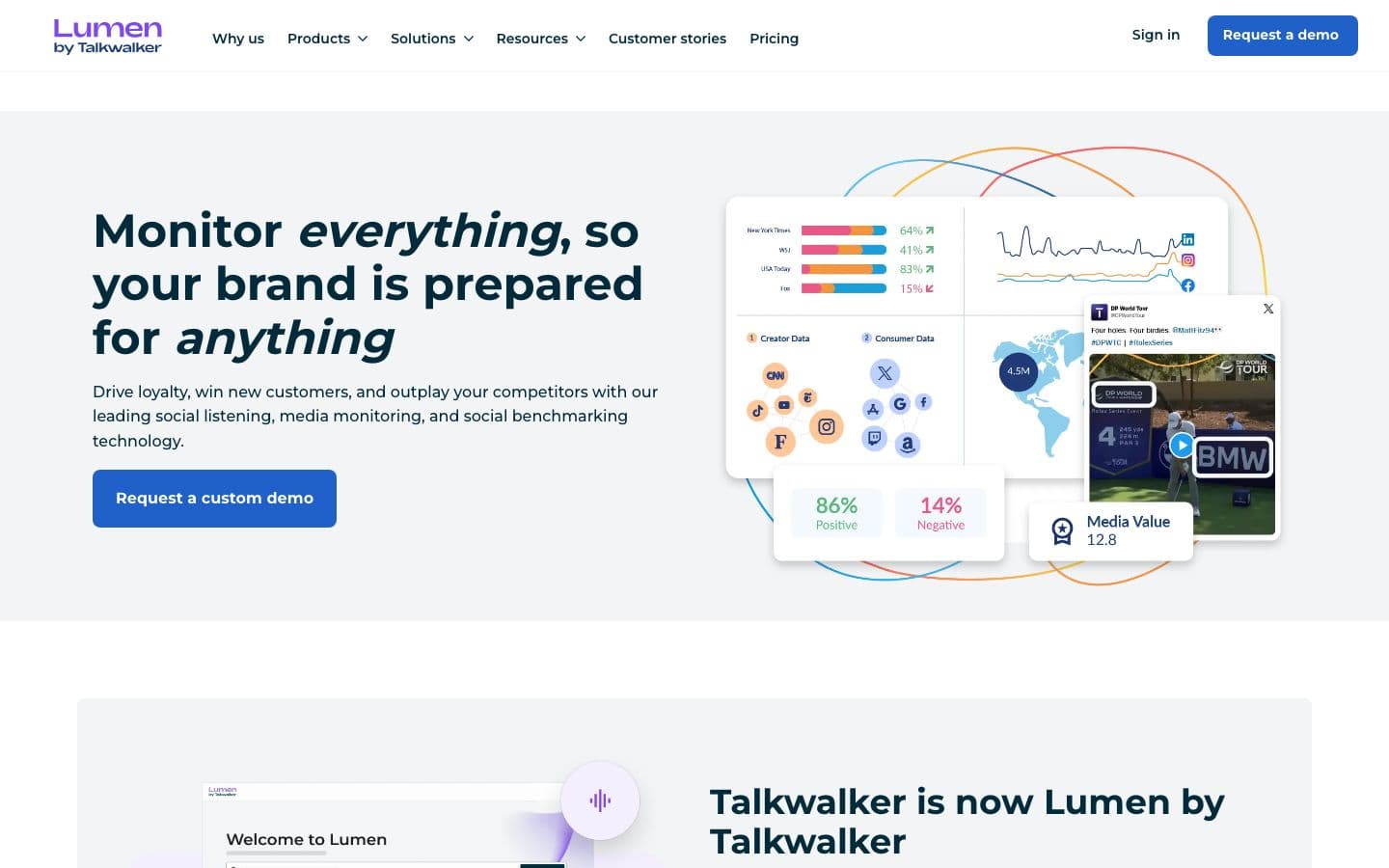
Talkwalker, now Lumen by Talkwalker
- Best for
- Enterprise brand and comms teams, especially those already on Hootsuite
- Starting price
- Not published. Full listening sits at Hootsuite Enterprise, custom-priced
- Free trial
- No self-serve trial, demo only
Pros
- Over 30 social networks, 150 million websites and around 300 review sources, by Hootsuite's count.
- AI detection of brand mentions in images, video and audio, which most tools never see.
- Wisdom, an AI layer for plain-language questions, summaries and forecasting.
- Sits alongside Hootsuite's publishing and engagement tools.
Cons
- No public price.
- The branding and packaging are mid-change as Hootsuite folds Talkwalker in, and it is not clear whether it is still sold on its own.
- G2 reviewers mention a hard initial setup and a price that is high for smaller budgets.
My take: strong if brand safety and visual mentions matter. Just ask plainly what you are buying and what it will be called on the contract. If you already pay for Hootsuite below Enterprise, know that its listening is basic: a 7-day lookback on Standard, no alerts, and no Instagram, LinkedIn or Reddit listening.
Meltwater
- Best for
- PR and communications teams who need news and social in one contract
- Starting price
- Not published. Annual agreements, 12-month minimum
- Free trial
- No self-serve trial, guided demo
Pros
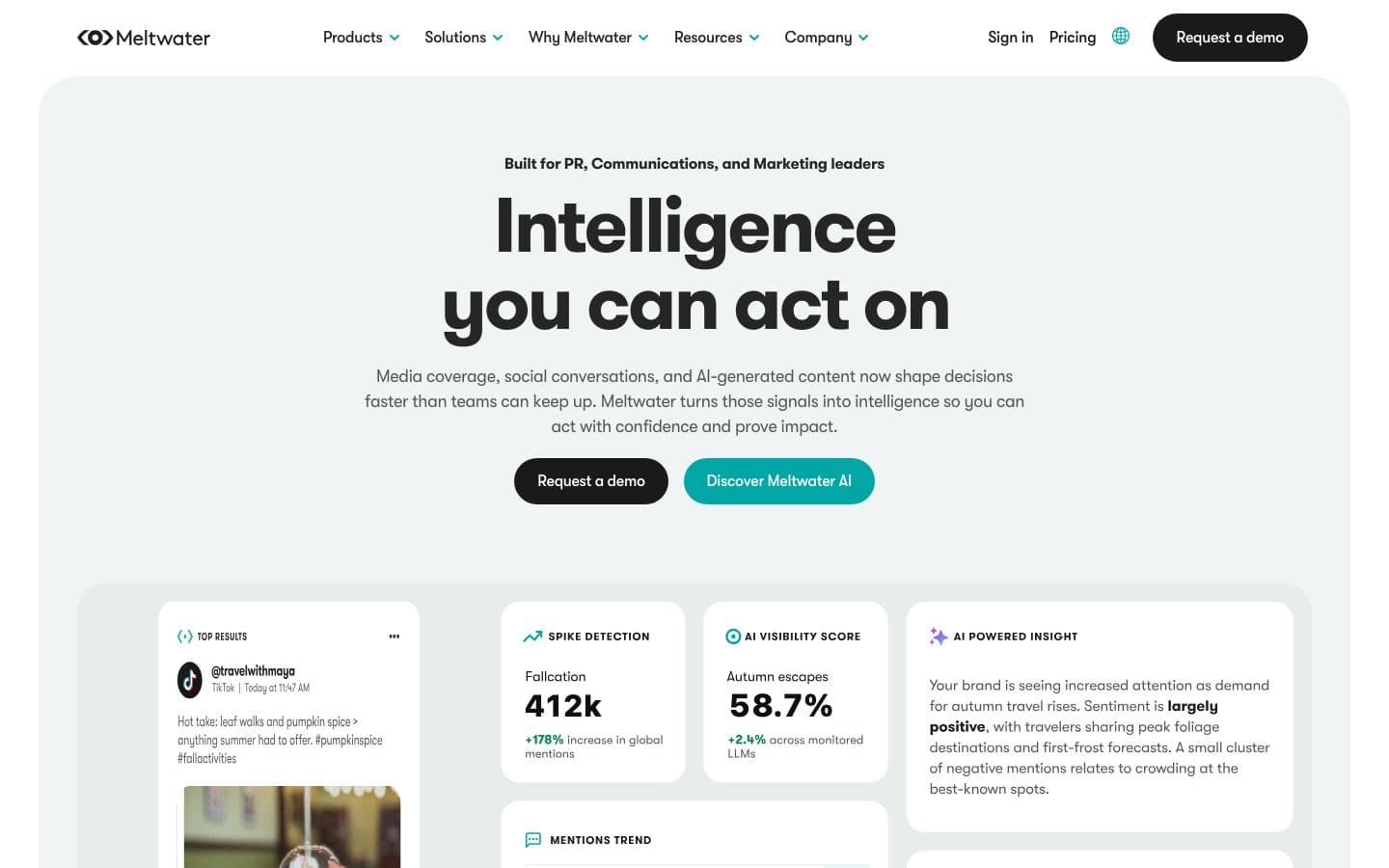
- News, including paywalled publications, in the same contract as social: Instagram, TikTok, Facebook, X, Reddit, YouTube, blogs, forums, reviews and podcasts.
- Editorial history back to 2009 and a rolling 15 months of social.
- Spike alerts into Slack or Teams, and Mira, an AI assistant with sourced answers.
- Support for over 240 languages.
Cons
- No public price and a stated 12-month minimum contract.
- No self-serve trial.
- G2 reviewers mention advanced features held in higher tiers and access that stops sharply at renewal.
My take: it makes most sense when press matters as much as social, because paywalled news is genuinely expensive to license. If press is a small part of your week, twelve months is a lot of commitment for it.
Sprout Social
- Best for
- Social teams that already publish and reply from Sprout
- Starting price
- $79 a seat on Essentials billed annually; $199, $299, $399 a seat above. Listening add-on not published
- Free trial
- 30 days, no card
Pros
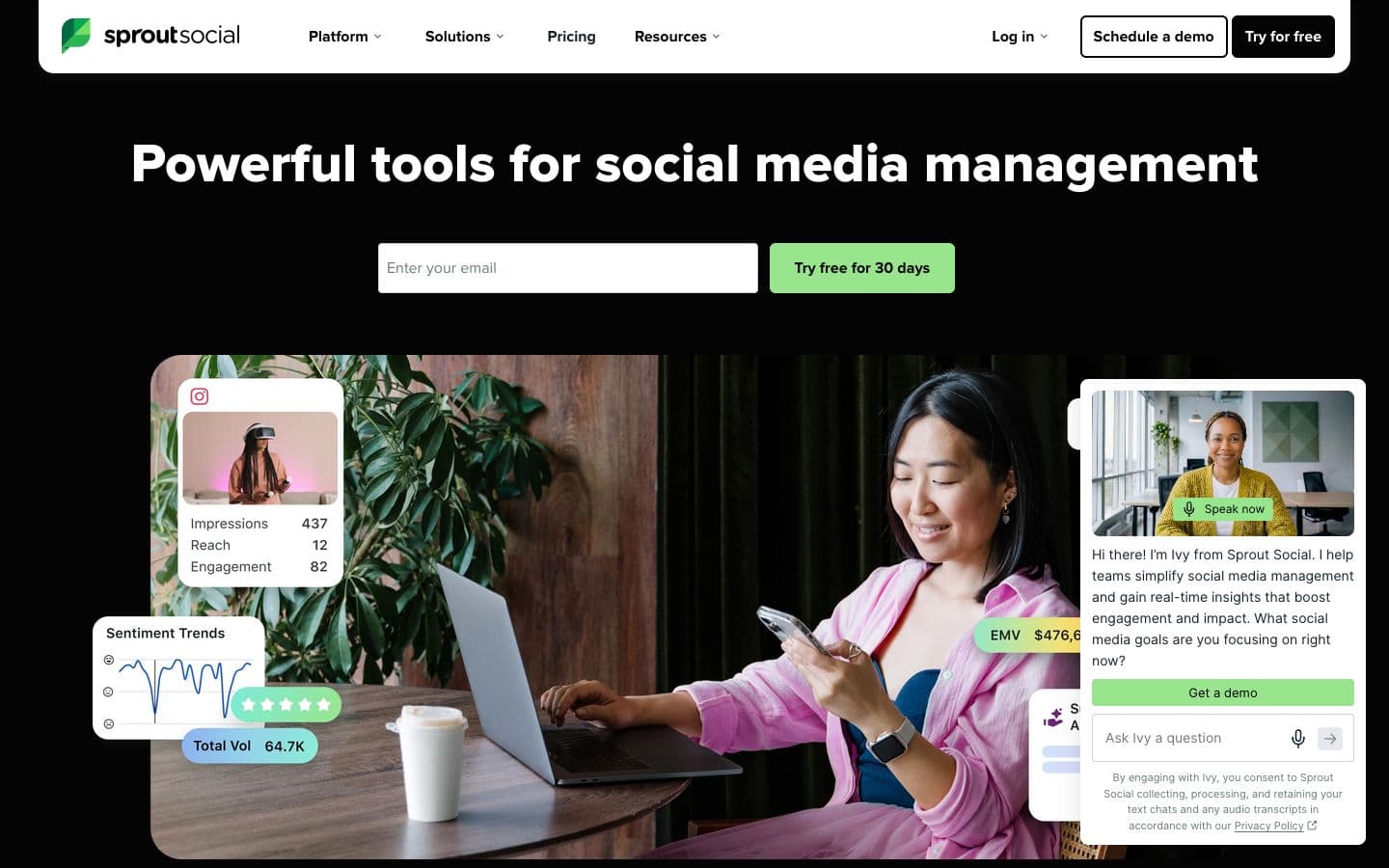
- Listening lives in the same tool your team already publishes and replies from.
- Seat prices are published.
- Listening across X, Facebook, Instagram, LinkedIn, Reddit, Tumblr, YouTube, TikTok and Bluesky, with news through an integration.
- Spike alerts, image monitoring and AI summaries.
Cons
- Listening is a paid add-on from the Standard plan up, and its price is not published.
- Per-seat pricing adds up: five seats on Standard is $995 a month at list price before listening.
- Sprout does not say whether the free trial includes listening.
My take: if your social team lives in Sprout, keeping listening in the same place is worth something real. Do the multiplication before the call, not after.
YouScan
- Best for
- Brands where the conversation is visual: food, fashion, beauty, retail
- Starting price
- $499/mo billed annually for 3 topics and 15,000 mentions
- Free trial
- Yes, set up after a demo
Pros
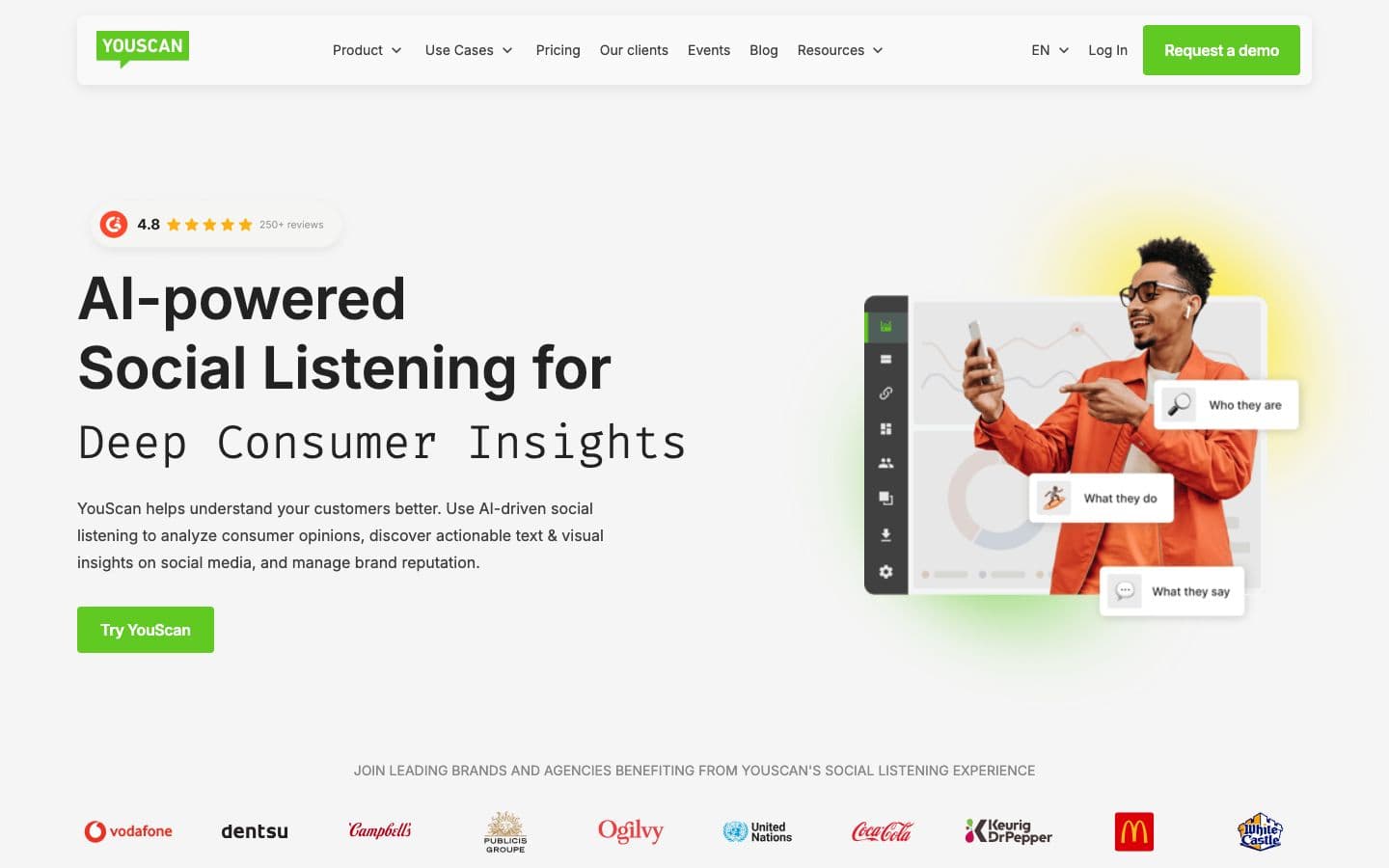
- Visual Insights detects logos, objects, scenes and activities in images.
- A published entry price, which is rare at this level.
- Unlimited users on every plan.
- Insights Copilot, a conversational AI over your data.
Cons
- The highest published entry price on this list.
- Visual Insights, the reason to choose YouScan, is bundled with the custom-priced Unlimited plan, not the $499 one.
- Billed annually, and the trial comes after a demo rather than self-serve.
My take: before you sign, confirm that the plan you are quoted includes the visual features. Without them, the cheaper tools below do the same job.
Mentionlytics
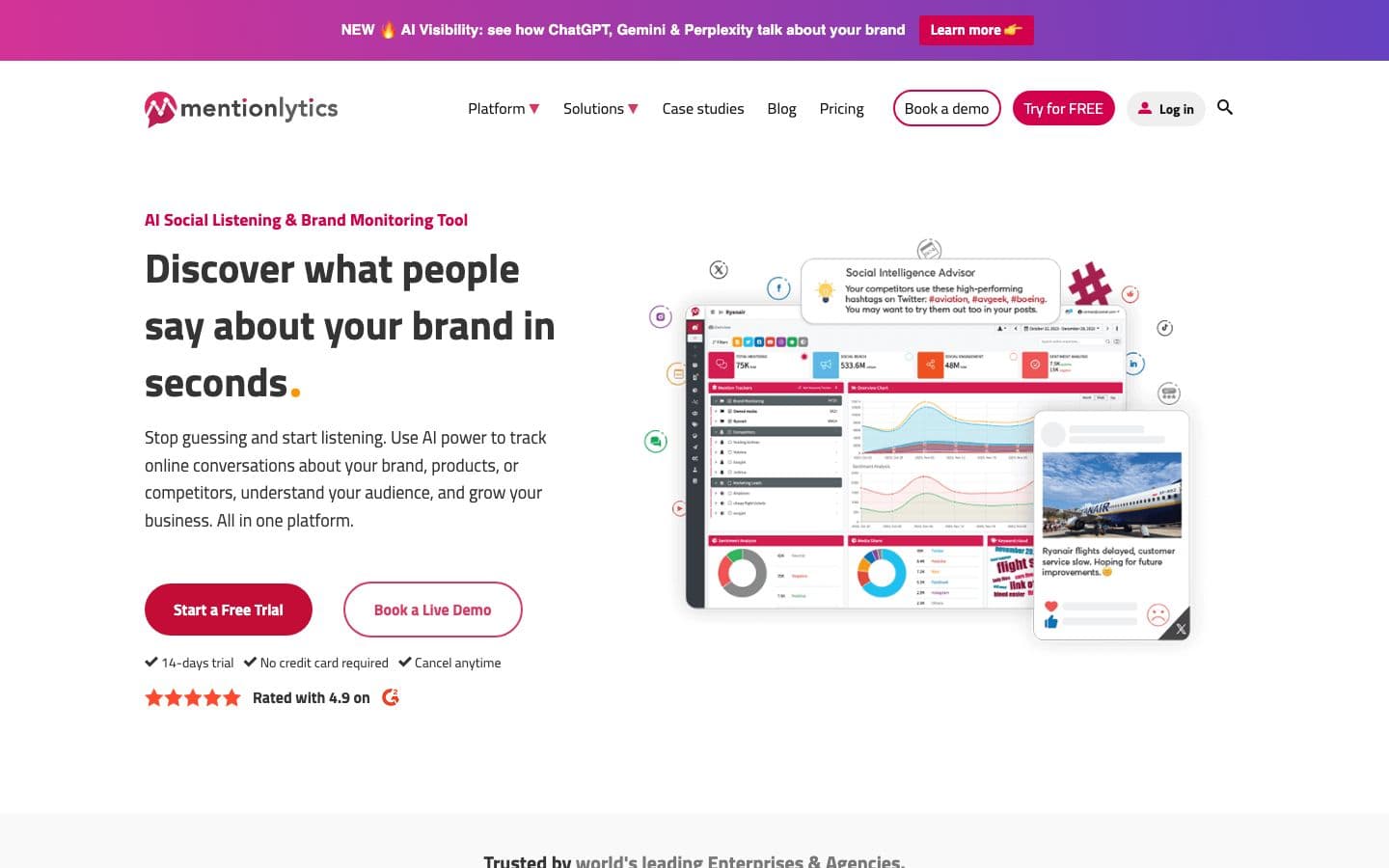
- Best for
- Brands where reviews matter as much as social
- Starting price
- $49/mo billed yearly for Basic. Essential $169, Advanced $299, billed yearly
- Free trial
- 14 days, no card
Pros
- Over 100 review sites alongside X, Facebook, TikTok, LinkedIn, Instagram, YouTube, Reddit, Bluesky, Threads, Telegram and podcasts.
- A low published entry price.
- An AI advisor, emotion analysis and spike alerts.
- The trial includes every feature.
Cons
- Basic is 3 keywords and 5,000 mentions, which a consumer brand uses up quickly.
- The published prices are yearly billing; monthly costs more.
- G2 reviewers mention restrictive mention limits and sentiment that misses sarcasm.
My take: the widest review-site coverage in the self-serve group. The product really starts at Essential, so price the $169 plan, not the $49 one.
Awario
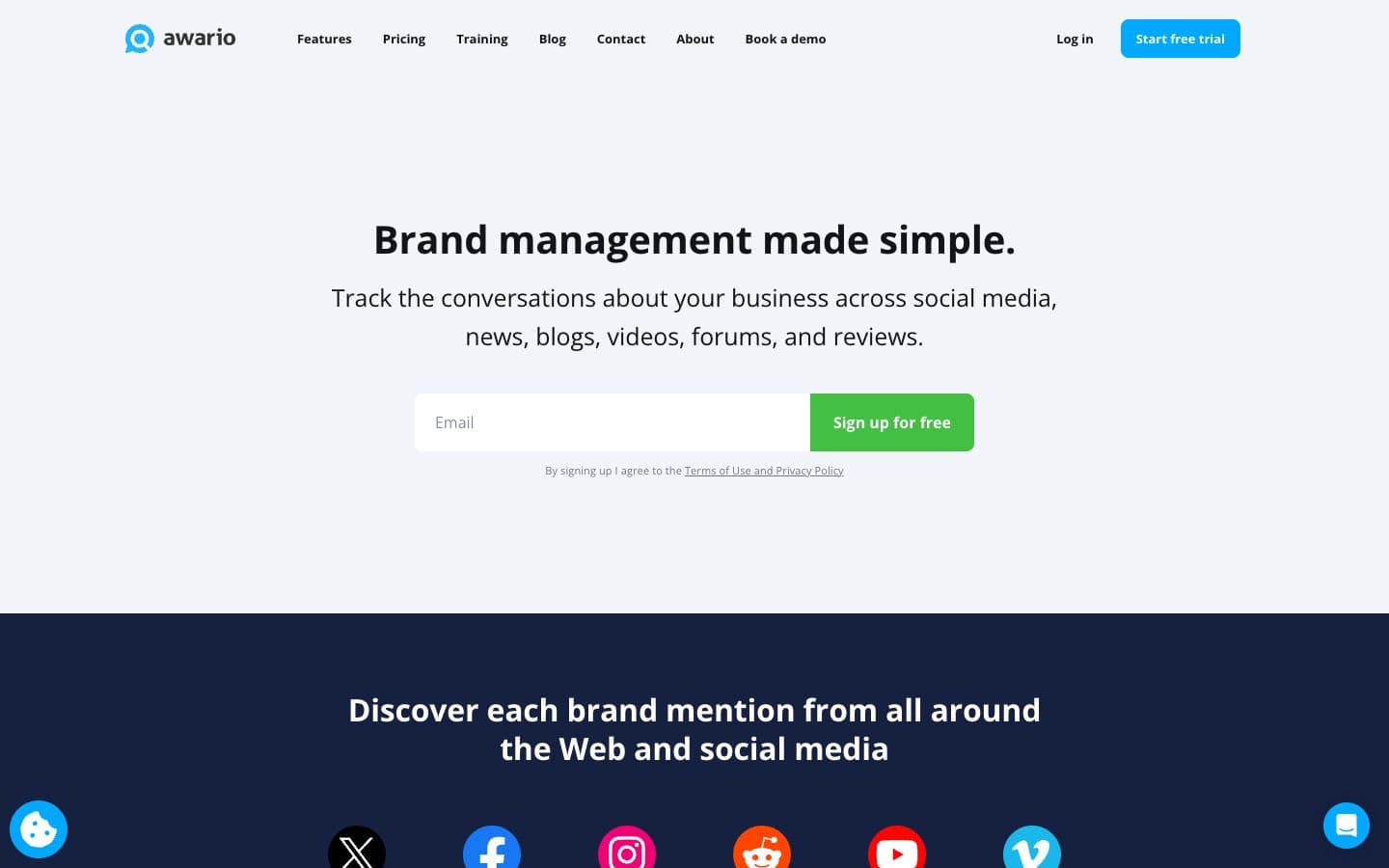
- Best for
- Small teams that need a lot of mentions for very little money
- Starting price
- $29/mo billed annually ($49 monthly) for 3 topics and 30,000 mentions
- Free trial
- 7 days, no card
Pros
- 30,000 mentions a month at $29 is the best mention-per-dollar on this list.
- Boolean search, API access and white-label reports listed on every plan.
- Unlimited keywords inside each topic.
Cons
- TikTok, LinkedIn and review sites are not named on its site.
- One seat on the Starter plan.
- G2 reviewers mention irrelevant results even with specific keywords, and missed mentions.
My take: check coverage before you celebrate the volume. If your customers talk on TikTok or LinkedIn, 30,000 mentions from elsewhere does not help.
Mention
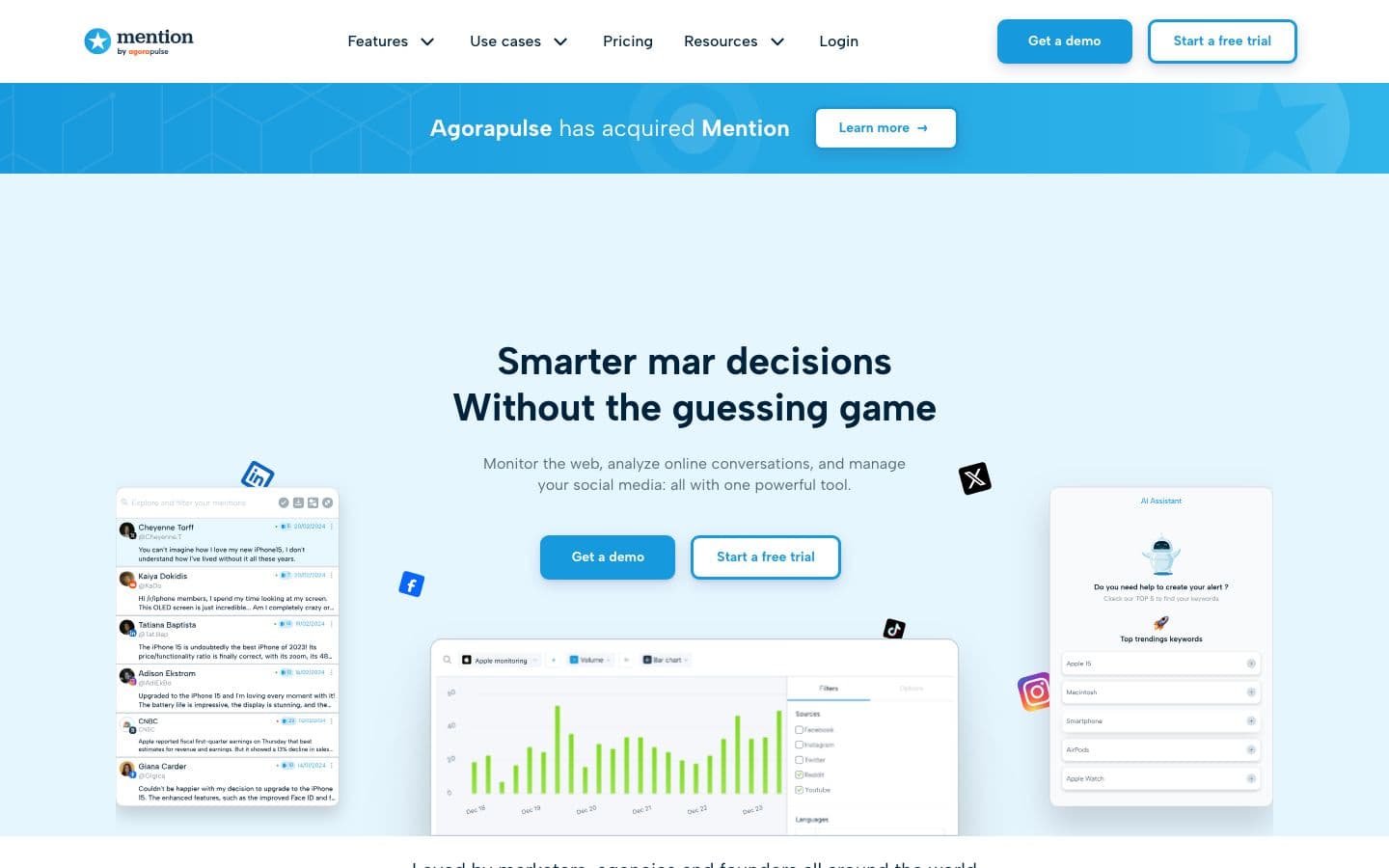
- Best for
- Mid-size brands and PR teams comfortable with a sales process
- Starting price
- Not published. One Company plan, price on request
- Free trial
- Yes, length not stated
Pros
- Over 75 review sites alongside Facebook, Instagram, X, Reddit, TikTok, Pinterest, YouTube, news, blogs, forums and podcasts.
- Boolean search, share of voice and competitor benchmarking.
- White-label exports in PDF, PowerPoint and spreadsheet formats.
Cons
- No public price.
- LinkedIn is not in its list of monitored sources.
- G2 reviewers mention a complex setup and many irrelevant mentions out of the box.
My take: solid coverage, especially on reviews. Mention is now part of Agorapulse. Go into the call knowing what the self-serve tools above would cost you for the same job.
Which one I would shortlist, by situation
| If you are… | Shortlist | Why |
|---|---|---|
| A team that wants to act on conversations, not just count them | BrandRobin | Buyer signals in their own feed and AI answers with sources |
| A team that wants the widest self-serve coverage | Brand24 | The longest named channel list with published prices |
| An insights team answering long-term category questions | Brandwatch | History back to 2008 and the widest network list |
| A comms team where press matters as much as social | Meltwater | Paywalled news in the same contract as social |
| A social team already publishing in Sprout or Hootsuite | Sprout Social, Hootsuite Enterprise | Listening in the tool you already use |
| A brand where the conversation is photos and video | YouScan, Talkwalker | Image and logo recognition |
| A small team that needs coverage on a budget | Awario, Mentionlytics | Published prices that start under $50 |
How to run a fair trial
Most trials are wasted because they are run on the vendor's demo data, or on two tools in two different weeks. A fair comparison takes about an hour of setup and a week of waiting.
- 01
Start two trials on the same day
Same brand name, same competitor, same week. Conversations change daily, so staggered trials compare two different weeks rather than two tools.
- 02
Use a thread you already know about
Pick a recent Reddit thread or review you know exists. Check whether each tool found it, and how long it took. It is the quickest honest test of coverage there is.
- 03
Read 50 mentions by hand
Score each one as relevant or not. The share of noise tells you more about day-to-day use than the headline mention count does.
- 04
Ask each tool one real question
Something your boss actually asked last month, like why sentiment dropped. See which tool gets you to an answer you would forward, with the sources to back it.
If you are working out a budget before the trials, I broke down what social listening actually costs, including where the API and white-label price jumps sit. If you are replacing a developer-focused tool specifically, the Octolens alternatives post covers that narrower market.
The short answer
There is no single best social listening tool in 2026. There is the best one for the purchase you are making. If you need research depth, press or broadcast, go enterprise and negotiate hard. If you need to know what people said this week and act on it, start with the self-serve tools, where you can see your own data before anyone asks for a signature.
And whichever you shortlist, see how social listening works with your own brand name in it. The right tool is the one that finds the conversation you did not know was happening.
Keep reading
Competitor Intelligence
7 Octolens Alternatives, With What Each One Actually Costs
Octolens Pro is $199 a month. Seven alternatives with their real entry prices, read off each vendor's own pricing page — including the free one, and the two that cost more than the thing you were trying to replace.
Read itPR & Crisis Management
How to Handle a Social Media PR Crisis
The worst decision is rarely the statement. It is the one made in the first twenty minutes about whether this is a crisis at all. A tier model, the test that separates a bad Tuesday from a real incident, and why a late response is a second incident rather than a weaker one.
Read itAnalytics & Reporting
How to Calculate Share of Voice (and Why the Denominator Decides the Answer)
The formula takes one division. Every decision that determines the answer happened before you divided. One company, one month and three defensible denominators that are 23 points apart.
Read it