Brand Management21 September 202611 min read
What Is Brand Monitoring and How Do You Start?
Most teams have alerts, not a record, and a tool with a blind spot reports silence exactly the way it reports a quiet week. What brand monitoring actually covers, how it differs from social listening, and a first week you can run before choosing a tool.
 Anil SalviCMO and co-founder, BrandRobin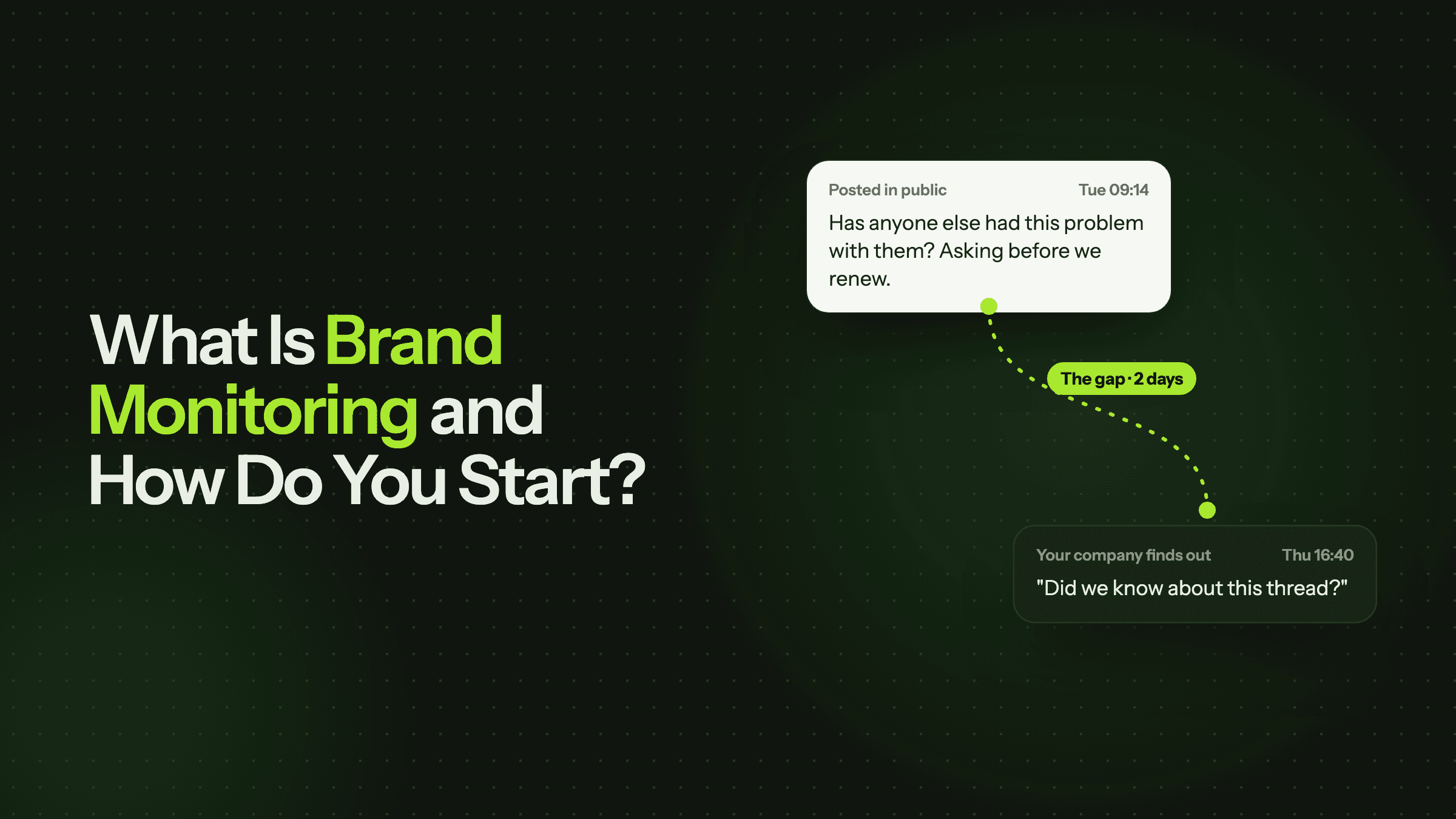
Most brand problems do not arrive through monitoring. They arrive through a person.
A salesperson forwards a screenshot. A customer mentions something in passing on a renewal call. Someone on the leadership team finds a thread at nine in the evening and asks whether we knew about this.
By the time that question reaches marketing, the conversation is usually days old and has already been read by everyone it was going to reach.
That gap is what brand monitoring is supposed to close. Not sentiment scores, not a dashboard, not a weekly report. The distance between the moment something is said about you in public and the moment your company finds out.
 Reddit
 LinkedIn
 YouTube
 Quora
Quora X
X Instagram
Most teams believe they have closed that gap. Very few have ever checked.
What is brand monitoring?
Brand monitoring is the practice of systematically finding what is said in public about your company name, your products, your people and your campaigns, and keeping one record of it that you can actually go back to.
Three words in that sentence do the work.
Systematically, meaning it happens whether or not anyone remembers to search this week.
Record, meaning the result is something you can question later. A notification is an event that happened to you once. A record is an asset.
Public, meaning you are reading what anyone could read. Brand monitoring is not surveillance, and the parts of the internet that are genuinely private stay that way. That matters more than most vendors admit, and I will come back to it.
That is the whole definition. It is deliberately unglamorous, because the difficult part of brand monitoring has never been the idea. It is the completeness.
The question that tells you whether you have it
Here is a test I would run on any marketing team, including one I was running myself.
Ask: what was said about us last Tuesday?
Not the mention count for the month. Not the sentiment trend. One ordinary day, two or three weeks back, on which nothing in particular happened.
Most teams cannot answer. They can tell you about the incident in March, because somebody escalated it. They can tell you what this month's number was. But an ordinary Tuesday has vanished, because nothing about it triggered an alert and nobody thought to write it down.
An alert tells you about the exception. A record lets you answer the question.
That distinction is most of the difference between a team that monitors its brand and a team that believes it does. Alerts are reactive by design: they fire on the things you already predicted would matter. The record is what lets you answer the things you did not predict, and in my experience that is where the interesting brand questions come from.
Brand monitoring and social listening are not the same job
These two terms get used as synonyms, usually by people selling a tool that does both. They are related, and they are not the same work.
| Brand monitoring | Social listening | |
|---|---|---|
| Asks | What was said, where, and when? | What does it mean, and what should we do? |
| Unit | A mention | A pattern |
| Succeeds when | Nothing was missed | Something was understood |
| Fails as | A hole in the record | A confident conclusion drawn from a partial record |
| Clock | Minutes and hours | Weeks and quarters |
| Usually owned by | Comms, support, brand | Marketing, product, leadership |
The order matters. A team that starts with listening before its coverage is honest ends up drawing conclusions from whatever happened to be easy to collect, which is usually the channels with the best APIs rather than the channels where the argument about your category is actually happening.
If you want the other half of this, I have written a longer piece on social listening and what to do with the patterns once you can see them. This article is about the layer underneath it.
Why "we already monitor our brand" is usually not true
Almost every company has something. Here is what that something usually is, and where each one leaks.
Google Alerts. Free, fast to set up, and limited to what Google has indexed as a page. A Reddit comment three levels deep, an Instagram comment under a creator's video, a mention forty minutes into a podcast, a message in a community. None of that arrives. Alerts are a headline feed, and most brand conversation is not a headline.
The social inbox. Your notifications catch the posts that tag your handle. That is a real and useful subset, and it is a small one. People write your name; they rarely write your handle.
RedditAnyone moved off Acme recently? We're up for renewal and the new pricing is hard to justify. Looking at two alternatives but I'd rather hear from someone who's actually switched.
Review site emails. Each portal notifies you about itself. Nobody reads three portals daily, and the reviews that hurt most are usually on the one your team checks least.
A person who is good at finding things. Every company has one. This works genuinely well until they are on leave, change role, or get busy during the exact week you needed them.
Each of these is fine on its own terms. The problem is what they share: none of them can tell you what they missed. A tool with a blind spot reports silence from inside the blind spot exactly the way it reports a quiet week.
The Tuesday audit
So go and measure the hole by hand. This takes about an hour, and it is the most useful hour you will spend on this subject.
- 01
Pick an ordinary day
Two or three weeks back. No launch, no incident, no campaign. You want a normal day, because normal days are what your setup has to survive.
- 02
Find five mentions yourself
By hand, from that one day. One in a community or forum, one review, one comment under somebody else's post, one in video or audio, one in a newsletter or trade publication. They exist. Give yourself an hour and you will find them.
- 03
Check how many your current setup has
Open whatever you call monitoring today and look for those exact five. Not similar ones. Those five.
- 04
Write down the shape of what is missing
Not the count, the shape. If the four you missed were all comments rather than posts, or all video, or all on one platform, you have just learned the specific edge your coverage stops at.
I have never seen this exercise come back clean, and the interesting output is never the number. It is the pattern in what got missed, because that is the same pattern that will hide the next real problem from you.
What a brand monitoring setup actually watches
When people set this up for the first time, they enter the company name and stop. The company name is the smallest and least interesting part of it.
- 01
Your name, and every way it is typed wrong
Acme Foods, Acme Food Co, AcmeFoods, Acme Food. The angry review is the one least likely to spell you correctly, and a setup that only matches the trademark will miss it cleanly.
- 02
Your products, separately from your company
Customers talk about the thing they use, not the entity that sells it. In plenty of companies the product name carries more conversation than the brand name does.
- 03
Your people
Founders, executives, anyone who speaks publicly. Praise and blame both attach to names faster than they attach to companies, and an executive's name is often where a story starts.
- 04
Your campaigns, taglines and hashtags
These have a short public life and they generate the most concentrated reaction you will ever get. They are also the thing nobody remembers to add to a watch list until the reaction has already happened.
- 05
Your own handles and tags
The part everyone starts with. Keep it, just do not mistake it for coverage.
- 06
The descriptions that stand in for your name
The company that does X. That CRM everyone uses. The one with the free tier. In a small category a description is as identifying as a name, and it is invisible to keyword matching.
Six lists, not one. It takes an afternoon to write and it is the part of this work with the highest return, because a mention you never told the system to look for is not a gap in the tool. It is a gap in the brief.
Where brand conversations actually live
The honest answer is that it depends on your category, and that any list presented as universal is being sold to you rather than reasoned out. A regional restaurant group and a developer tools company do not share a single important surface.
That said, the centre of gravity has moved, and it has moved in a direction worth naming. In Sprout Social's Q2 2025 pulse survey of more than 2,200 social users across the US, UK and Australia, 37% said they go to social platforms first when looking for product reviews and recommendations. People increasingly ask other people before they ask a search engine.
Which means the surfaces that matter for monitoring are less "the big social networks" and more "wherever your specific buyers ask each other questions".
Two of them are worth naming, because they are the ones almost every setup misses for the same structural reason.
YouTube
Video is the surface most monitoring quietly skips, because the mention is usually spoken aloud or buried in a comment rather than written on an indexed page.
It is also unusually durable. A review video recorded two years ago can still be the first thing a buyer watches, and the comments under it keep accumulating long after the creator has moved on.
YouTubeNegativeI had this exact setup for a year. It works fine until you need support, and then you're on your own. Check their help docs before you buy, that tells you everything.
Quora and the question sites
Question sites are where a buyer states their problem in their own words, before anyone has sold them a way of describing it.
That makes them the clearest read you will get on the language your market actually uses, and the answer a stranger writes underneath becomes the durable one, because question pages age well in search.
QuoraWhat are people actually using for brand monitoring in 2026, and is it worth paying for versus just setting up alerts?
Those two are worth sitting with, because they are the ordinary case. Neither is a crisis. Neither would ever be escalated to anyone. Both are doing real and durable work on how your brand is understood by people who have not yet spoken to you.
How to start: the first week
If I were setting this up from nothing, this is the order I would do it in. Note how much of it happens before any tool is chosen.
- 01
Write the watch list
The six lists above, in a document, agreed with whoever owns comms. This is the brief every later decision depends on, and it costs an afternoon.
- 02
Name the surfaces you are watching, and the ones you are not
A surface you have consciously decided to skip is a decision you can revisit. A surface nobody ever considered is a hole you will discover during an incident.
- 03
Define urgent before anything is urgent
Two or three tiers, written down. Anything alleging harm, safety or legal exposure is tier one. A negative review from an ordinary account is not. Agreeing this in a calm week is the whole trick, because nobody classifies well at 11pm.
- 04
Route each tier to a person
Not to a channel. A shared Slack channel is where alerts go to be read by nobody in particular. Every tier needs a named owner, a backup, and a response time everyone has actually agreed to.
- 05
Run for thirty days before you judge anything
You need a baseline. Without one you cannot tell a spike from a Tuesday, and every number you look at in month one will be read as either a triumph or a disaster when it is neither.
Four of those five steps are decisions, not software. That is not an argument against buying a tool. It is an argument for knowing what you are asking a tool to do before you compare them, which is also the only way to run a trial that tells you anything.
The four numbers worth watching at the start
Resist the dashboard with forty metrics on it. At the beginning, four will do.
Volume against your own baseline. Not against an industry benchmark, which is a number from a different company in a different category in a different week. Your normal is the only thing your normal should be compared to.
Coverage by channel. What share of the record comes from each place. This is the number most teams never look at, and it is the one that exposes a broken integration. A channel that has gone quiet for a fortnight looks exactly like a channel where nothing was said.
Sentiment, as a tripwire. Useful for noticing that something changed. Not useful as a verdict.
Automated sentiment still struggles with sarcasm, with industry jargon, and with the difference between someone criticising your category and someone criticising you. Treat a move as a reason to go and read, not as a finding.
Time from published to seen. The number nobody tracks, and the one that actually describes whether any of this is working. If something posted at 9am is first read by your team at 4pm the next day, you do not have a coverage problem. You have a routing problem, and more channels will not fix it.
If you want the longer argument about why raw volume is the weakest of the four, I have made it separately in why mention counts lie.
What brand monitoring will not do
Worth being straight about this, because the category tends not to be.
It will not tell you why. Monitoring gives you what was said and where. The reason behind a pattern is still a human judgment, informed by the record rather than produced by it.
It will not fix the thing people are complaining about. If forty people say your onboarding is confusing, the monitoring worked perfectly. The work is somewhere else, and no amount of dashboard will do it.
It cannot see private spaces, and nothing honest can. Direct messages, private groups, closed communities, the WhatsApp thread where three people decided not to renew. A meaningful share of what is said about you is genuinely unobservable, and a vendor implying otherwise is either overselling or doing something you do not want to be part of.
It is not reputation management. Knowing is a precondition for acting, not a substitute for it. A team that monitors carefully and responds to nothing has bought an expensive way to feel informed.
Where this leads
Once the record is reasonably complete, the useful questions change.
You stop asking whether anyone is talking about you and start asking what keeps coming up. You notice the same objection appearing in three unrelated places and realise it belongs to sales rather than to social. You see a competitor's name turning up beside yours in comparisons you were never part of. You become able to answer what changed this month with something more specific than a percentage.
That is the point where monitoring turns into something a business can use, and where a mention in a thread starts to read as a buyer signal rather than a statistic. It is also where watching what gets said about your competitors starts to be worth the effort, which is a related discipline and a genuinely useful one.
None of it works on a record with unexplained holes in it. Coverage first.
Why we built BrandRobin the way we did
This is the thinking behind how we approach brand monitoring: the difficult, unglamorous part is completeness, so that is the part we built for.
Seventeen channels, named individually rather than totalled into a round number, because a list can be checked and a number cannot. Name variants and misspellings treated as part of the brief rather than as an advanced feature. Duplicates merged, so a syndicated story counts once. And the last thirty days backfilled before you log in, because a monitoring tool that starts empty is asking you to wait a month before it can answer anything.
None of that is exciting. It is the part that decides whether the record you are reading is worth the decisions you make from it.
Final thoughts
Brand monitoring gets described as a defensive function, and it is usually sold on fear: the crisis you missed, the review that spread, the thread that ran for four days before anyone noticed.
Those things happen, and they are not the reason to do this.
The reason is that a complete record of what people say about you in public is one of the few genuinely unfiltered inputs a company has. It is not what customers tell you when you ask them. It is not what your team believes is true. It is what people say to each other when the company is not in the room.
Getting it right is mostly a matter of deciding what to watch, being honest about where you are not looking, and making sure that something found at nine in the morning reaches a person the same day.
The goal is not to know everything said about your brand. It is to stop being the last to know the things that matter.
And to be able to answer, without a week of searching, what was said about you last Tuesday.
Keep reading
Analytics & Reporting
How to Measure Brand Awareness (Without a Survey)
A brand tracker costs real money, arrives six weeks late and measures a prompted moment. Meanwhile people search your name, argue about your category and leave you off shortlists every day. Four traces worth reading instead, and where a survey still wins.
Read itCompetitor Intelligence
10 Brand24 Alternatives in 2026: What Each One Locks Behind an Upgrade
Read itMedia Monitoring
Social Media Search Engines in 2026: What You Can Actually Search
Reddit's instructions to every search engine are two lines long, and the second one is Disallow. What eight platforms permit, what you can still search for free, and the point at which searching stops being the right verb.
Read it