Analytics & Reporting21 September 20269 min read
How to Calculate Share of Voice (and Why the Denominator Decides the Answer)
The formula takes one division. Every decision that determines the answer happened before you divided. One company, one month and three defensible denominators that are 23 points apart.
 Anil SalviCMO and co-founder, BrandRobin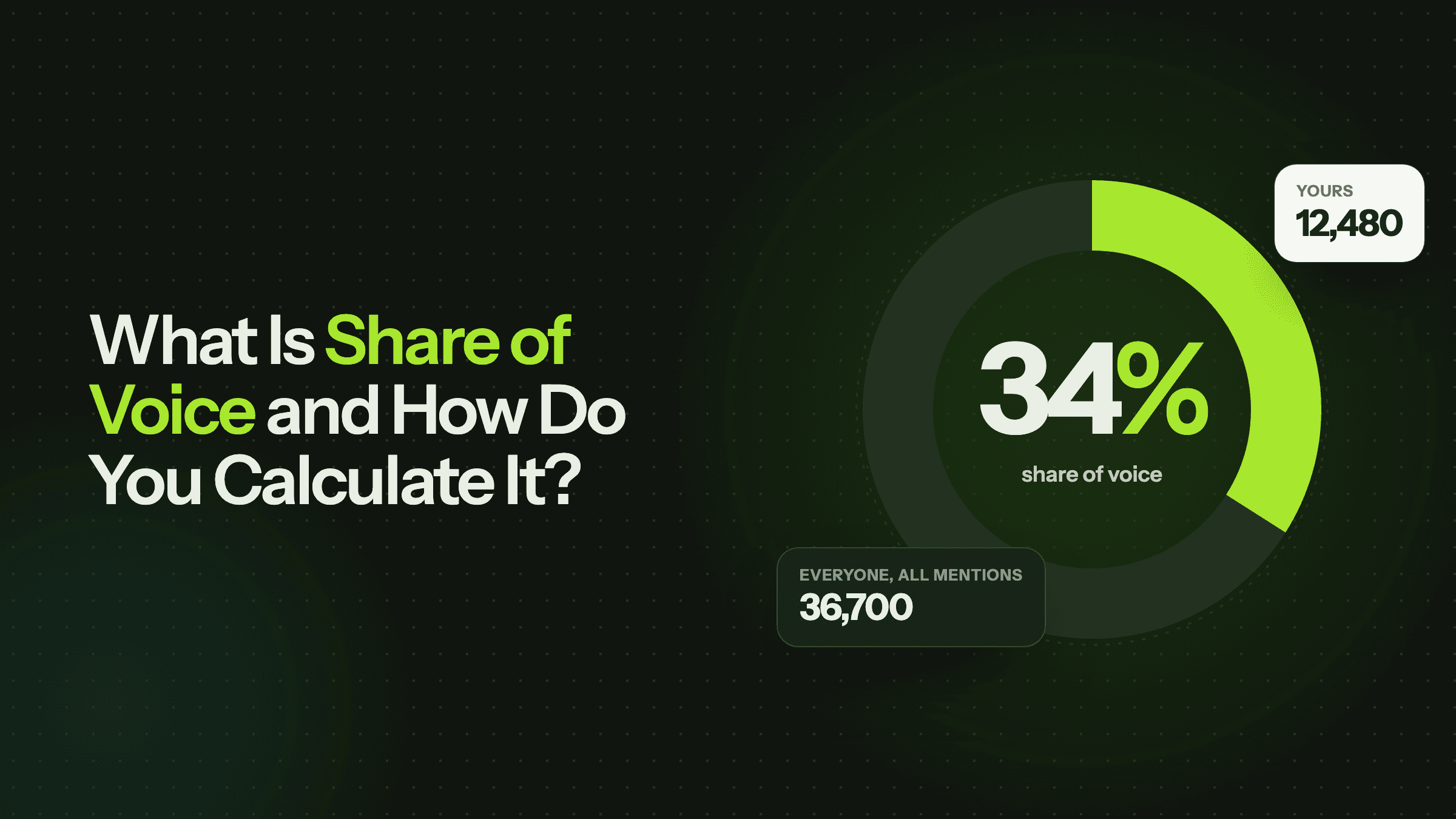
Share of voice has the simplest formula in marketing measurement. Your mentions, divided by everyone's mentions, times one hundred.
That simplicity is the problem. A number that takes one division to produce looks objective, and share of voice is one of the most subjective figures on a marketing dashboard. Every decision that determines the answer was made before anyone divided anything.
I have watched two people present share of voice for the same company in the same month and give numbers eleven points apart. Neither had made an arithmetic error.
 Reddit
 X
X LinkedIn
 YouTube
 Quora
Quora Medium
So this is less a post about a formula and more about the four or five judgements sitting underneath it, which is where the number is actually decided.
The formula, and why it is the least interesting part
Here it is, in full.
Share of voice = your mentions ÷ total mentions of every brand you are tracking × 100.
Suppose that over thirty days you were mentioned 12,480 times, and the brands you track were mentioned 36,700 times between you. Your share of voice is 34%.
That is the whole calculation, and if you want it stated plainly with a worked table, we keep a short reference version of exactly that on the share of voice question page.
Now the parts nobody writes down.
Which brands are in that 36,700. Which channels the counting covered. Whether every brand was counted the same way. Whether a press release syndicated to forty outlets counted once or forty times. Whether a mention in a thread about a rival's outage counts as your voice or theirs.
The arithmetic takes a second. Everything that decides the answer happened before you divided.
What it measures, and what people think it measures
Share of voice measures how much of the public conversation about a named set of brands is about you. That is all it measures.
It does not measure how many people know you, which is a different question with different traces. It does not measure whether people like you, because a mention counts the same whether it is praise or a complaint. And it very much does not measure market share, though the two get conflated so often that we wrote a separate page on why they are not the same.
What it is genuinely good at is one thing: telling you whether you are gaining or losing ground in the conversation relative to the specific companies you compete with. That is a narrow claim and a useful one.
One company, one month, three correct answers
This is the part I would put in front of anyone who thinks share of voice is an objective number.
Take one company, one thirty-day period, one set of mention data. Now watch what happens as you change nothing except who is in the denominator.
| Denominator | Who is in it | Your share of voice |
|---|---|---|
| The three you pitch against | You and the two competitors that show up in your deals | 34% |
| The category as buyers describe it | The above, plus two adjacent tools buyers also consider | 24% |
| The category as an analyst defines it | All of the above, plus two incumbents and a free tier | 11% |
All three numbers are correct. All three are calculated properly. And a marketing team under pressure will reach for 34% without anyone lying about anything.
The lesson is not that share of voice is useless. It is that the number is meaningless without its denominator stated next to it, in the same way a percentage change is meaningless without a base. A share of voice figure presented without the brand set is not a measurement, it is a claim.
Choosing the denominator is a positioning decision
Here is the part I find genuinely interesting, and it is the reason I think CMOs should own this metric rather than delegating it.
When you decide which companies go in your denominator, you are answering the question "who do we compete with". That is not a measurement decision. That is positioning, and it has consequences well beyond a chart.
Name three competitors and you are claiming a tight, well-defined market. Name nine and you are claiming a broad one where you are a smaller fish. Include the free tool everyone starts on and your share collapses, but you learn something real about where your buyers actually come from.
My rule, for what it is worth: the denominator should be the set your buyers consider, not the set your strategy deck lists. Those two are different in almost every company I have seen, and the gap between them is usually more interesting than the share of voice number itself.
Then, having chosen it, freeze it. Adding a brand later drops everyone's share including yours, which looks like decline and is arithmetic. If you must change the set, recalculate the history on the new set so the trend stays readable, and say in the footnote that you did.
Four different numbers, all called share of voice
A lot of confusion in this area comes from people using one term for four things. They answer different questions and they are not interchangeable.
Mention share. Every mention counts once. The default, the easiest to audit, and the most honest starting point. Its weakness is that a mention in a thread nobody read counts the same as one in a thread twenty thousand people read.
Reach-weighted share. Mentions weighted by estimated audience. More sophisticated on the surface, and built on reach figures that are modelled rather than observed. It usually flatters whoever gets covered by large outlets. Use it if you like, and label it, because it is not comparable with anyone's mention share.
Search share. Your branded search volume as a proportion of branded search across the tracked set. A genuinely useful cousin, because searching for a brand is unprompted behaviour rather than someone talking about you. It is also the only one of the four you can calculate from free tools.
Spend share. Your media spend over category media spend, usually called share of spend. Nothing to do with conversation. It belongs in the same report, which is the subject of a later section, but calling it share of voice causes real damage because it makes budget look like brand strength.
Mixing any two of these produces a number that cannot be compared with anything, including your own figure from last quarter.
When your share of voice going up is bad news
Share of voice counts mentions. It does not care why anyone is talking.
So the fastest way to increase it is a crisis. A product recall, an outage, a badly judged campaign, an executive in the news for the wrong reason. Your mentions go vertical, your competitors' do not, and your share of voice has a spectacular month.
XNegativethird hour of this outage and still nothing on their status page. genuinely asking, what are people using instead? I cannot go through this again next quarter
Which is why I would never show share of voice on its own. At minimum, put the sentiment split beside it, so a rise can be read as growth or as trouble.
A month like that one, with a third of the conversation negative, is not a month where 40% share of voice means what the slide implies. Some teams go further and calculate a sentiment-weighted share, counting only neutral and positive mentions. That is defensible, it is harder to audit, and it should be labelled as clearly as reach weighting.
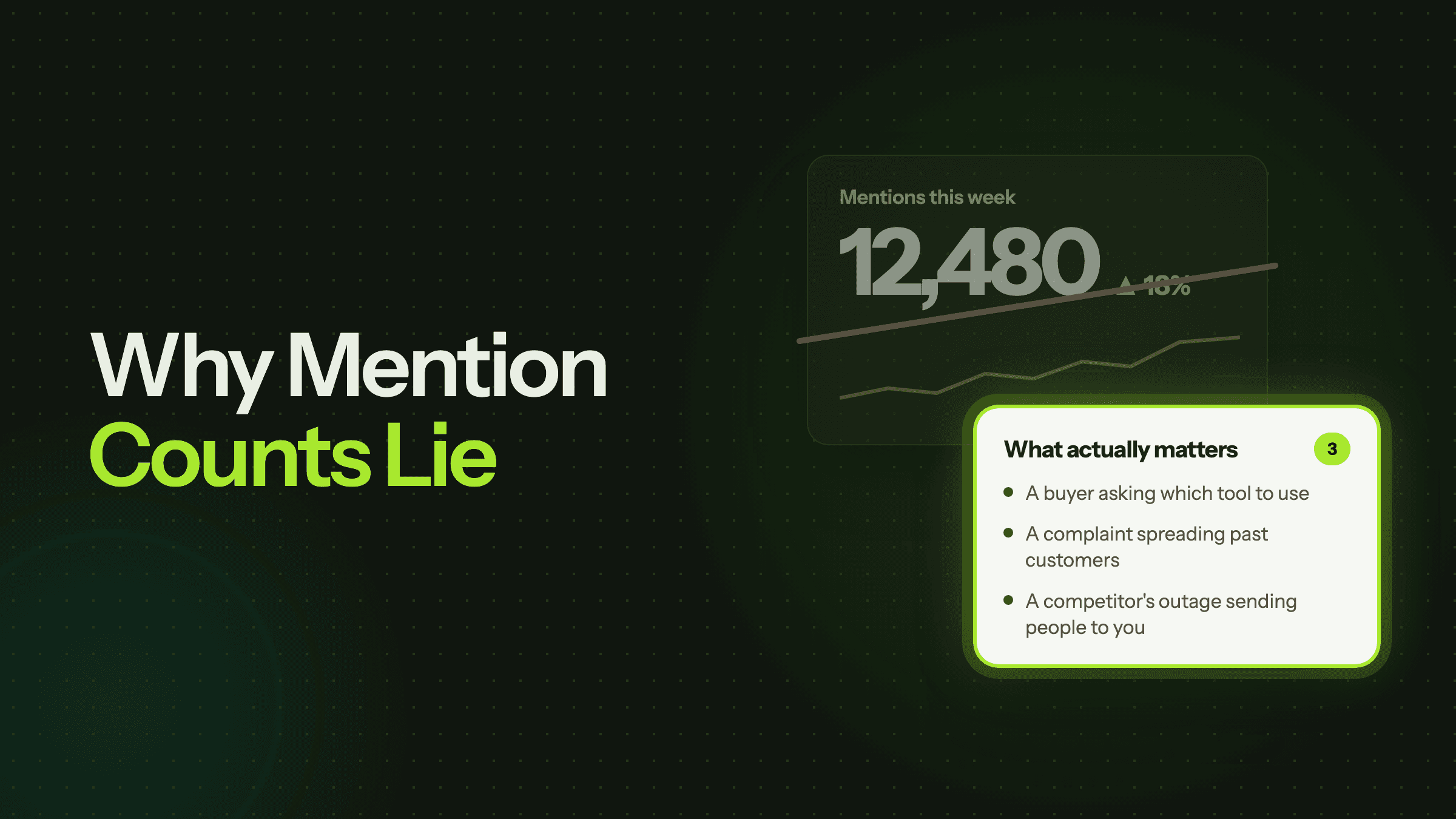
The general version of this warning is that volume is the weakest signal on any dashboard, which I have argued at length in why mention counts lie. Share of voice inherits every one of those weaknesses and adds a denominator you chose.
Excess share of voice, and the only reason most CMOs care
There is one use of share of voice that justifies the whole exercise, and it is not the standalone number.
Compare your share of voice against your share of the market. The gap between them has a name, excess share of voice, and it comes out of Les Binet and Peter Field's analysis of the IPA databank, which is the most substantial body of evidence in this area.
The idea in one sentence: brands whose share of voice runs ahead of their market share tend to grow, and brands whose share of voice sits below their market share tend to shrink. Being talked about more than your size warrants is the leading indicator. Being talked about less than your size warrants is the warning.
What makes this genuinely useful is that it turns share of voice from a vanity number into a diagnostic. On its own, 34% means nothing. Sitting next to a 19% market share, it says you are punching above your weight and growth is plausible. Sitting next to a 52% market share, it says you are coasting on a position you are no longer earning.
Share of voice on its own is trivia. Share of voice against market share is a forecast.
How to calculate it the first time
- 01
Fix the period
Thirty days is the usual unit, and whatever you pick has to be identical for every brand. Comparing your thirty days against a competitor's seven is the most common invisible error in this metric.
- 02
Name the brand set, and write down why
Three to five, chosen because buyers actually consider them. Put the reasoning in the same document, because the person who inherits this in a year will otherwise change it without knowing what it cost.
- 03
Fix the channels, identically for everyone
If you are read across seventeen channels and a competitor across five, your share is inflated by the twelve channels where they cannot appear. This is the single biggest source of dishonest share of voice numbers, and it is usually accidental.
- 04
Deduplicate before you count
One press release syndicated across forty outlets is one event. Counted forty times it can swing a small category for a week and it will look like momentum.
- 05
Divide, then write the denominator on the chart
The number and the brand set travel together from here on. A share of voice figure that arrives without its set will be misread by someone within a quarter, usually in a board pack.
Note that four of those five steps happen before any counting, and that the counting is the part a tool does for you. The judgement is the work.
How often to look at it
Monthly or quarterly. Not weekly.
Weekly share of voice is dominated by news events and reads as noise. Somebody launched something, somebody had an outage, a large account posted. None of that tells you whether your position in the category is changing, and watching it weekly trains a team to react to weather rather than climate.
The exception is during a campaign or an incident, where you are deliberately watching a short window for a specific reason and you know what you are looking at.
Where BrandRobin fits
The hard part of share of voice is not the division, and a tool that only tracks your own name cannot help with any of it.
What actually matters is the denominator being real: your competitors read across the same channels, on the same scale, over the same period as you, deduplicated with the same rules, so the fraction means something. That is the whole job, and it is why we treat competitor tracking as part of measurement rather than as a separate feature.
It also depends on coverage underneath it. A share of voice number calculated from a partial record is a confident-looking answer built on an unknown denominator, which is the argument for getting brand monitoring right before reporting any of this upward.
Final thoughts
Share of voice is worth measuring. It is one of the few marketing numbers that is genuinely comparative, it moves before revenue does, and it can be checked against the conversations underneath it.
It is also the easiest number on the dashboard to produce a flattering version of, without anybody doing anything dishonest. Pick a tighter denominator, count a channel your competitors are not measured on, let a syndicated story through undeduplicated, and you have a better quarter.
So the discipline is not in the calculation. It is in writing down the brand set and refusing to quietly change it, measuring everyone the same way, keeping sentiment next to the number, and comparing it against market share rather than against last month's version of itself.
Anyone can calculate share of voice. The work is being able to say exactly what it is a share of.
Keep reading
PR & Crisis Management
Online Reputation Management: A Complete Guide
Your reputation is not a sentiment score. It is what a stranger finds in the ten minutes they spend checking you, and most of it was built by accumulation rather than by any crisis. What actually moves it, what does not, and where to start.
Read itSocial Listening
What social listening actually costs in 2026
Almost nobody in this category publishes a real price. Here is what the tools charge, where the jumps are, and what a realistic year one costs for two ordinary teams.
Read itAnalytics & Reporting
Why mention counts lie
Volume is the easiest number on a listening dashboard to move and the least useful one to read. Here is what to put in front of a CMO instead.
Read it