PR & Crisis Management21 September 202611 min read
Online Reputation Management: A Complete Guide
Your reputation is not a sentiment score. It is what a stranger finds in the ten minutes they spend checking you, and most of it was built by accumulation rather than by any crisis. What actually moves it, what does not, and where to start.
 Anil SalviCMO and co-founder, BrandRobin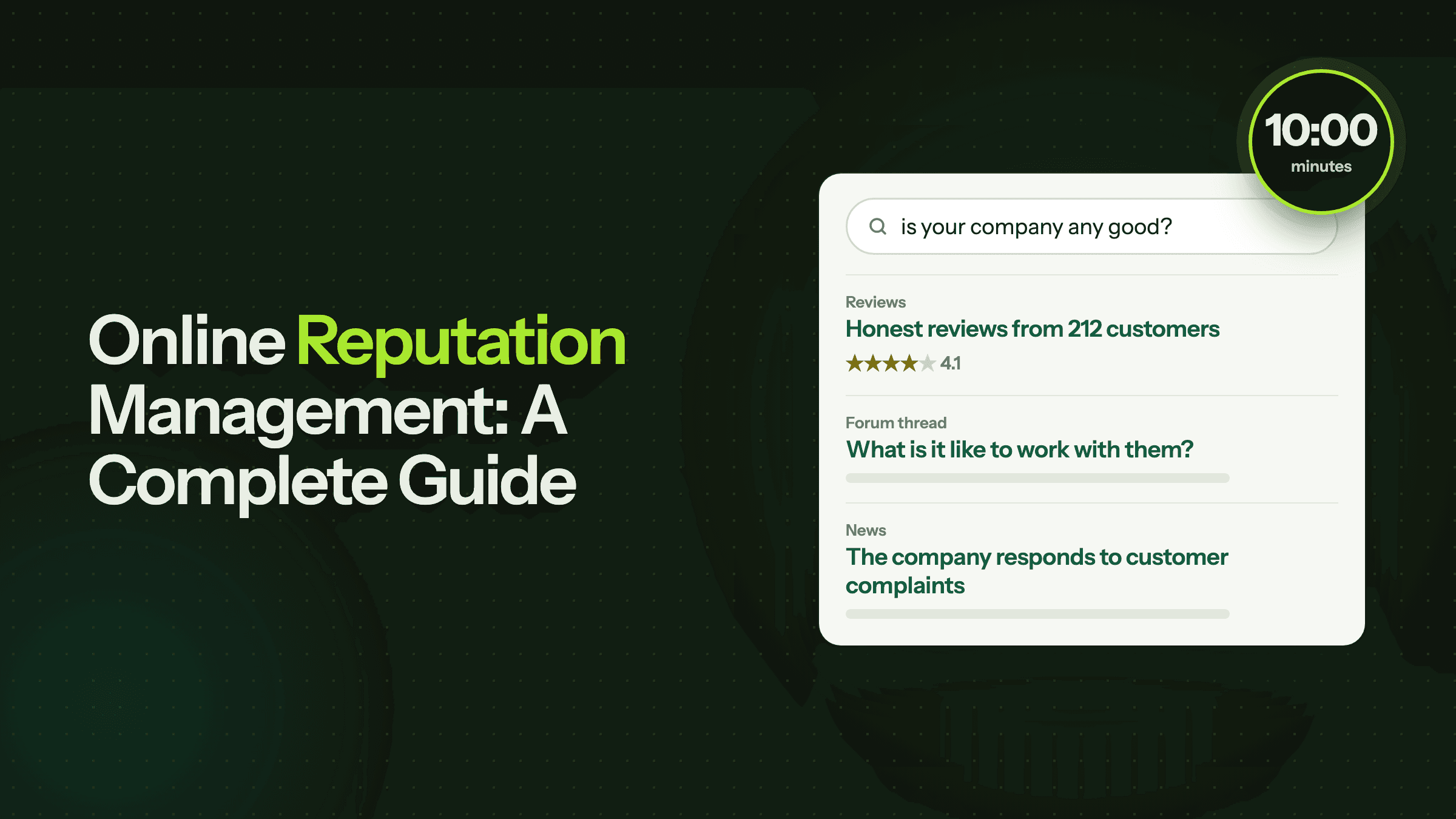
There is a moment every company has and almost none of them ever sees.
Someone who has never heard of you is given your name. A colleague mentioned you, or you came up in a shortlist, or an assistant suggested you. They open a browser and spend about ten minutes deciding whether you are worth a meeting.
They read the first page of results. They skim a review site. They find a thread where three people who are not you discuss what you are like to work with. They may never visit your website at all.
That ten minutes is your reputation. Not your sentiment score, not your brand guidelines, not the deck. What a stranger finds when they check.
 Reddit
 X
X LinkedIn
 Quora
Quora YouTube
 Medium
Online reputation management is the work of deciding what that person finds. Most of the advice written about it treats the job as crisis response. In my experience the crises are the small part.
What online reputation management actually is
Online reputation management is the practice of shaping what people find when they look you up: making the accurate things easy to find, making the inaccurate things answerable, and fixing the underlying problems that keep generating the same complaint.
Three parts, and teams usually only do the first one badly and skip the other two.
What is said. Reviews, threads, comments, articles, posts. You do not control this and never will.
What is findable. Of everything said about you, the small subset that surfaces in the first page of results, in the top three reviews, in the thread a search returns. This you can influence.
What is answered. The questions people ask about you that currently have no good answer anywhere, so they get answered by whoever wrote something first.
Notice what is not in that list. Reputation management is not deleting things. The part of this discipline that gets sold hardest, removal, is the part that works least often and backfires most spectacularly.
Your reputation is what a stranger finds, not what you score
A lot of teams measure reputation as a sentiment percentage and stop there.
Suppose your dashboard says 78% positive. That sounds healthy. Now suppose the first result for your brand name plus the word "review" is a three-year-old listicle that puts you fourth, the second result is a competitor's comparison page, and the third is a forum thread titled "anyone else having problems with their billing?".
Your sentiment score is still 78%. Your reputation is whatever those three pages say, because those three pages are what the person checking you actually reads.
Sentiment measures the conversation. Reputation is the small part of that conversation a stranger can find in ten minutes.
So start by looking at what they see.
- 01
Open a private window
No account, no history, no personalisation. You want the page a stranger gets, not the page Google has learned to show you.
- 02
Run the five searches people actually run
Your brand name on its own, then with review, then with vs, then with alternative, then with the word problems or a complaint word from your category. These five cover most of how buyers check a company.
- 03
Write down the first ten results for each
Mark which you own, which are neutral third parties, which are competitors, and which are negative. This grid is your reputation, stated more honestly than any score.
- 04
Ask an assistant the same questions
Is this company any good. What do people complain about. What are the alternatives. Read the answer and, more importantly, notice which sources it leaned on.
That exercise takes half an hour and it is usually uncomfortable, which is the point. It is the reputation equivalent of the Tuesday audit, and most teams have never run either.
Your reputation now has a machine reader
This is the part that has changed most, and the part most reputation advice has not caught up with.
For twenty years the job was to influence a list. Ten blue links, and a person who would look at several of them and form their own view. A bad result on page one was a problem, but it sat next to nine other results and the reader did the weighing.
An assistant does not return a list. It returns a summary, and a summary has no page two.
If the three or four sources it leans on happen to agree on something inaccurate about your pricing, your support or your ownership, that inaccuracy becomes the answer. Not one result among ten. The answer, delivered in a confident paragraph, to everyone who asks.
RedditAnyone actually used these guys? Site looks fine but I can't find much about them and the one review I found was pretty negative. Are they legit or should I look elsewhere?
Two practical consequences follow, and they are not the ones people expect.
Consistency across sources beats polish on your own site. An assistant weighing what is true about your pricing is comparing your page against three others. If your own site is the only place a number appears, it carries less weight than the same number appearing in four places that agree.
Pages that show their working get quoted. A claim with a source, a date and a checkable number is more useful to a machine trying to be accurate than a beautifully written page of adjectives. This is why we publish the Explore pages in the format we do: one question per page, answered in the first paragraph, with the sources underneath.
If nobody has written a good answer to "is this company any good", something will still answer it. The only question is what.
Most reputation damage is not a crisis
Ask a marketing team about reputation management and you will usually hear about a crisis: a bad campaign, a viral thread, a founder's post that aged badly.
Those happen. They are also the rare case, and they are the case a company handles best, because a crisis has three things going for it. Everyone notices it. Someone senior owns it. It ends.
The damage that actually accumulates has none of those.
Fourteen reviews left unanswered over a year. The same support complaint appearing in nine separate threads, none of which is big enough to escalate. A comparison page written by a competitor that has quietly ranked for your brand name since March. An old article with a wrong price that nobody has asked to be corrected.
Not one of those is an incident. Together they are what the stranger finds.
A crisis has an owner. Accumulation has none, which is exactly why it accumulates.
XNegativethird time this week the export has failed silently. support told me it's "expected behaviour". at what point is expected behaviour just a bug you've decided not to fix
What actually moves reputation, and what does not
There is a lot of folklore in this field. Here is my honest read on the common tactics, in rough order of how often I see them tried against how often they work.
| Tactic | What it actually does | Worth it? |
|---|---|---|
| Responding to reviews | Changes how the review reads to the next person, not how the reviewer feels | Yes, the highest return per hour in this whole list |
| Asking happy customers to review | Shifts volume and recency, which is what review platforms weight | Yes, if you never incentivise or filter who you ask |
| Publishing your own answers | Gives search engines and assistants a citable source where none existed | Yes, and it compounds |
| Fixing the underlying problem | Stops the complaint being generated in the first place | Yes, slowest, and the only durable one |
| Burying results with thin content | Moves a result down for a while, until the thin pages get discounted | Rarely, and it leaves you with pages nobody wants |
| Legal threats to remove a post | Converts a small complaint into a story about a company that sends legal threats | Almost never, see the Streisand effect |
That last line is the whole discipline, as far as I can tell. You cannot subtract your way to a good reputation. Every removal tactic either fails, or works temporarily, or draws attention to the exact thing you wanted buried.
How to respond, and when not to
The most common mistake in responding is forgetting who the response is for.
You are not writing to the person who complained. That person has already decided, and quite often they are not going to change their mind in public. You are writing to the two hundred people who will read the thread over the next two years while deciding whether to buy from you.
Write the reply for the reader who arrives eight months later, because that is who it is actually addressed to.
That reframe changes the tone of almost every reply. It makes you shorter. It makes you specific. It stops you arguing, because arguing reads badly to a bystander even when you are right.
Respond when there is a factual error worth correcting, a real question nobody has answered, a problem you have genuinely fixed since, or enough visibility that silence itself becomes the story.
Do not respond when the post is in obvious bad faith, when the matter is already being handled privately and saying so adds nothing, or when your reply would hand a quiet complaint a much larger audience. Judging that last one correctly is most of the skill.
And when you do respond: own the part that is yours, say what changed, and leave the door open. Three sentences beat three paragraphs. A reply that reads like it came from a legal review reads like a company with something to hide.
Reviews are the part most teams get wrong
Review platforms are where reputation is most visible and most misunderstood.
The misunderstanding is that the average rating is the number that matters. It is not, or at least it is not on its own.
A 4.3 average across two hundred reviews, the newest from last week, is a stronger signal than a 4.9 across eleven reviews, the newest from 2023. The first looks like a real company that a lot of people use. The second looks like either a very small company or a very old page, and a buyer cannot tell which.
Three things that actually matter, in order: volume, because it tells a reader the sample is real. Recency, because a page whose newest review is two years old reads as a company that stopped. Then the average.
Which suggests an unglamorous habit rather than a campaign: ask consistently, at the moment someone has just got value, without incentives and without filtering who gets asked. Incentivised reviews read as incentivised, platforms penalise them, and a reader who spots one discounts every other review on the page.
How to start: the first thirty days
If I were taking this on from nothing, in a company that has never done it, this is the order.
- 01
Run the check, and write down what you found
The private window exercise above. Until you have that grid, every other decision is guesswork about a page you have not read.
- 02
Fix the record you control
Your own site, your profiles, your listings, your pricing page. Wrong or missing information on a surface you own is the cheapest reputation problem there is, and the most embarrassing to still have in month six.
- 03
Give responses an owner and a clock
One named person, a target response time, and a short written policy for what gets answered and what does not. A response policy invented during an incident is a response policy invented badly.
- 04
Start the review habit
Pick the one or two platforms your buyers actually read, and ask consistently from this week. Volume and recency take months to build, which is the argument for starting in month one rather than in the quarter you need them.
- 05
Answer the three questions nobody has answered
Whatever kept coming up in the check. Put a clear, dated, checkable answer on your own domain. This is the part that keeps working while you are asleep.
Notice there is no crisis plan in that list. Write one, by all means, but write it after these five. A crisis plan protects you from the rare case. These five change the ordinary case, which is the one running every day.
What to measure
Reputation resists measurement, which is why so many teams fall back on a sentiment percentage that moves for reasons nobody can explain.
Five things I would actually track:
Share of the first page you influence. Of the top ten results for your brand name, how many are yours, neutral, or hostile. Re-run it quarterly. It moves slowly and it moves for real reasons.
Review volume and recency, ahead of the average. A rating that is stable while volume grows is a healthier picture than a rating climbing on four reviews.
Response rate and time to respond. The only two numbers in this list you fully control, which makes them the ones worth holding a team to.
Recurring themes, and whether they are shrinking. If the same complaint appears in fewer places this quarter than last, something upstream actually got fixed. That is the measurement that connects reputation work to the product.
What assistants say when asked about you. Ask the same three questions monthly, keep the answers, and read them as a set. The drift over six months tells you more than any single answer.
A sentiment split like this is worth glancing at and worth very little on its own. It tells you the weather, not the climate, and it is the number most likely to be quoted at a board meeting without context. We have written separately about what a good sentiment score even means, and the short version is that the number only means something against your own history.
What reputation management cannot do
Being straight about the limits, because this field oversells harder than most.
It cannot delete something true. A published review, a news article, a thread that genuinely happened. Removal requests for accurate content fail, and the attempt frequently becomes the new story.
It cannot outrun a product problem. If people keep writing the same complaint, the complaint is the message. Reputation work applied to an unfixed problem is expensive noise, and the team doing it will burn out being blamed for a number they cannot move.
It cannot be done entirely by an agency. Responses that sound like nobody who works there wrote them read exactly like that. The parts that can be delegated are monitoring, reporting and drafting. The judgement cannot be.
It is not fast. Volume, recency and first-page position all move over quarters. Anyone promising a transformed first page in thirty days is describing either thin content or something you would not want to explain later.
Where monitoring ends and reputation work begins
These two get sold as one product and they are two jobs.
Brand monitoring is the record: finding what was said, where, and when, completely enough that you can trust the gaps are real gaps. Social listening reads that record for patterns. Reputation management is what you do about it, and it is the only one of the three that involves publishing anything.
The sequencing matters, because reputation work done on a partial record is worse than none. You end up responding to whatever happened to be loud, while the complaint repeating quietly in the threads nobody tagged you in carries on ranking.
That is the case we built BrandRobin for: the untagged thread, the review on the platform nobody checks, the comment under someone else's video. Not so there is another dashboard, but so the response goes to the thing that is actually shaping what a stranger finds.
Final thoughts
The companies I have seen handle reputation well are rarely the ones with the best crisis plan. They are the ones where somebody reads what customers write, answers it in public, and sends the recurring problems to whoever can fix them.
That is unglamorous work and it does not photograph well in a quarterly review. It is also the only version that compounds, because every answered question and every corrected fact stays answered and corrected, working on your behalf for years.
The alternative is not neutral. A reputation you do not tend does not stay still. It gets written by whoever did turn up: the competitor with the comparison page, the customer whose complaint went unanswered, the assistant summarising four sources that nobody checked.
Someone is going to answer the question "are they any good?" The only decision you get is whether you were part of that answer.
Keep reading
Social Listening
What social listening actually costs in 2026
Almost nobody in this category publishes a real price. Here is what the tools charge, where the jumps are, and what a realistic year one costs for two ordinary teams.
Read itAnalytics & Reporting
Why mention counts lie
Volume is the easiest number on a listening dashboard to move and the least useful one to read. Here is what to put in front of a CMO instead.
Read itSocial Listening
What a buyer signal actually looks like
A mention tells you your name came up. A buyer signal tells you someone is shopping. They are different objects, and treating them as one is why listening tools get cancelled.
Read it