Platform Guides3 September 20263 min read
Reddit is where your category argues
The most honest conversation about your product happens in a thread nobody tagged you in. That is inconvenient, and it is also the point.
 Anil SalviCMO and co-founder, BrandRobin
There is a version of your product that exists only in threads you have never read. It has features you did not ship, a reputation you did not write, and a price people believe it costs. That version is the one your buyers meet before they meet your website.
Most of it lives on Reddit, on Hacker News, in a Discord you were not invited to, and in the replies under a post that never tagged you.
Why the honest conversation happens there
The mechanics are not complicated. On a channel you own, people are talking to you. On a forum, they are talking to each other, and you are the subject rather than the audience.
That single change does most of the work. Nobody softens a complaint for a stranger. Nobody writes a careful, diplomatic review when they are answering "has anyone actually used this". They just say the thing.
A review is written for the company. A thread is written for the next person with the same problem.
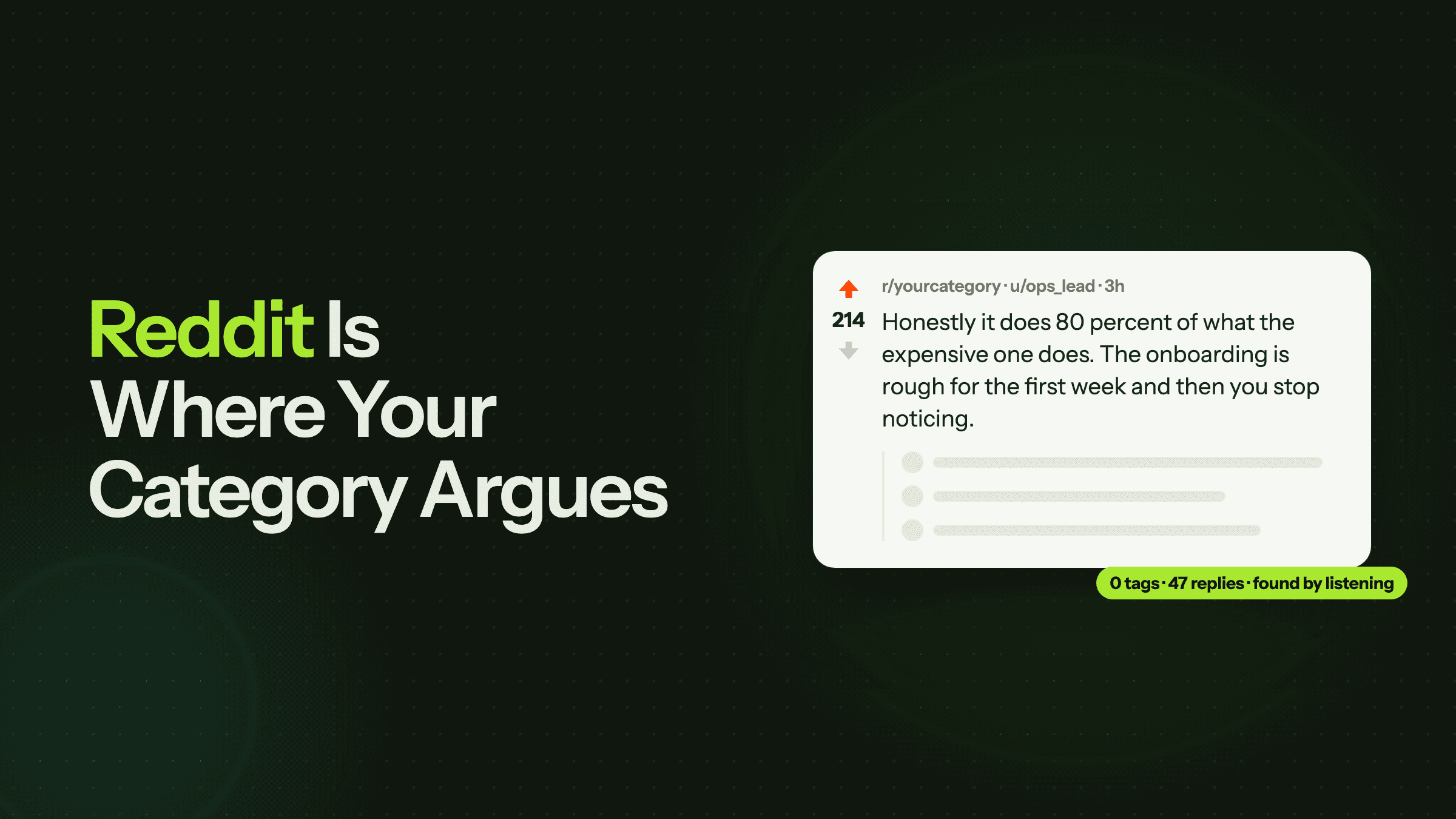
 RedditSpike
Honestly it does 80 percent of what the expensive one does. The onboarding is rough for the first week and then you stop noticing.
What you are actually looking for
Not your brand name. Your brand name is the easy case, and a keyword alert already covers it.
The valuable material is one level up, in the category:
- The words people use for the problem. Almost never the words in your marketing. This is free positioning research, written by the people you are trying to reach.
- The comparisons people make unprompted. Which tools get named in the same breath as yours tells you who you are actually competing with, which is often not who your deck says.
- The objections that repeat. One person calling your onboarding rough is an anecdote. The eleventh is a roadmap item.
- The workarounds. When people describe rigging two tools together to get an outcome, they have specified a feature for you in more detail than most user interviews will.
The part that makes it hard
Reading forums does not scale, and it does not scale in a specific way: the cost is not in reading, it is in finding.
A thread worth reading is surrounded by several hundred that are not. It is in a subreddit you would not have thought to check. It uses none of your keywords, because the person writing it does not know your product exists, which is precisely why they are asking. By the time it surfaces somewhere obvious enough to spot by hand, the question has been answered, usually by someone recommending a competitor.
The habit worth building
Pick the five places your category argues. Not fifty. Five. Read them properly once a week, and have something read them continuously in between so the threads reach you while replying is still useful.
That is the whole practice. Everything else in a listening tool, including ours, is machinery for making that habit survive a busy quarter.
Keep reading
Social Listening
What Is Social Listening? A Practical 2026 Guide
Your customers are already telling you what they like, what they hate and what they are comparing you against. A practical guide to finding those conversations, reading the patterns inside them, and turning them into decisions.
Read itBrand Management
What Is Brand Monitoring and How Do You Start?
Most teams have alerts, not a record, and a tool with a blind spot reports silence exactly the way it reports a quiet week. What brand monitoring actually covers, how it differs from social listening, and a first week you can run before choosing a tool.
Read itAnalytics & Reporting
How to Measure Brand Awareness (Without a Survey)
A brand tracker costs real money, arrives six weeks late and measures a prompted moment. Meanwhile people search your name, argue about your category and leave you off shortlists every day. Four traces worth reading instead, and where a survey still wins.
Read it