PR & Crisis Management21 September 202610 min read
How to Handle a Social Media PR Crisis
The worst decision is rarely the statement. It is the one made in the first twenty minutes about whether this is a crisis at all. A tier model, the test that separates a bad Tuesday from a real incident, and why a late response is a second incident rather than a weaker one.
 Anil SalviCMO and co-founder, BrandRobin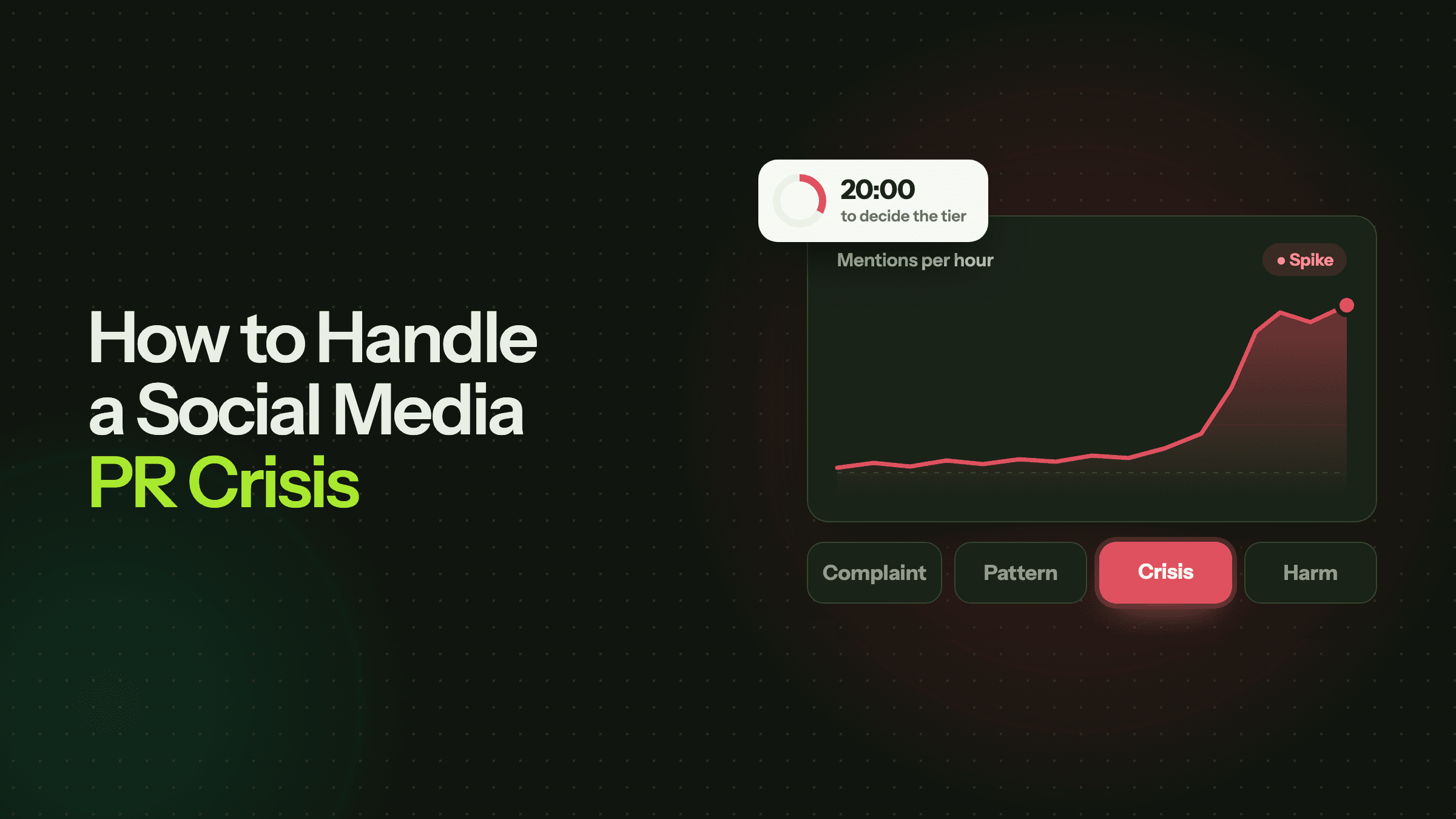
The worst decision in a social media crisis is almost never the statement. It is the decision, made in the first twenty minutes by someone with an elevated heart rate, about whether this is a crisis at all.
Get that wrong in one direction and a thread runs for four days before anyone senior hears about it. Get it wrong in the other and you answer nine angry replies with a corporate statement, which introduces the story to several thousand people who had no idea anything had happened.
I have come to think the second mistake is the more common one, and the one nobody writes about.
 X
X Reddit
 LinkedIn
 TikTok
 YouTube
 Instagram
This is the piece I deliberately left out of the reputation guide, where I argued that the ordinary case matters more than the rare one. It still does. But the rare one needs a plan, and a plan written during an incident is written badly.
Most of what gets called a crisis is not one
Somebody is angry in public. That is a Tuesday.
A complaint, even a well written and widely liked one, is not a crisis. Ten complaints about the same thing is a pattern, which is a product problem wearing a communications costume. Neither becomes a crisis because it made someone on your team feel sick to read it.
The reason this distinction matters is that the response is different in kind, not degree. Complaints get answered by whoever normally answers them. Patterns get routed to whoever can fix the underlying thing. A crisis gets a different process, a different speed and a different signer, and running that process over a complaint is how you manufacture the thing you were afraid of.
A crisis response applied to an ordinary complaint does not defuse it. It promotes it.
The test: has the conversation left the room?
Volume is the wrong test, which is the general argument I have made in why mention counts lie and which is never more expensive than it is here.
The test I would use instead: has this reached people who do not use your product?
While a conversation is happening among your own customers, in your own communities, it is a support and product matter. They have context, they have a relationship with you, and most of them want the thing fixed rather than punished. When it jumps to people with no relationship to you at all, the conversation stops being about the incident and starts being about what kind of company you are. That is the moment it becomes a crisis, and it can happen at two hundred mentions or at two hundred thousand.
| Tier | What it looks like | Who owns it | Public response |
|---|---|---|---|
| Complaint | One person, unhappy, in your own space | Support | Reply, normally |
| Pattern | The same complaint from several people in a week | Product, with comms informed | One public answer, plus a fix |
| Crisis | It has left your customers and is being discussed by people with no relationship to you | Comms, with a named decision maker | Yes, fast, once, then updates |
| Harm | Safety, legal exposure, a regulator, or anyone hurt | Legal and the executive team | A different process entirely |
Two signals, to make the difference concrete. The first is not a crisis.
XNegativefourth time this month the export has silently failed. i have a client call in an hour. genuinely how is this still not fixed
The second one is.
RedditSpikeSaw this doing the rounds. Never used them, but the part that gets me is the three days of silence while people were posting receipts. That tells you more than the bug does.
Notice that the second could easily be the smaller of the two by any count you care to run.
The first thirty minutes
In order, and the order is the point.
- 01
Establish whether it is true
Not whether it is fair, not whether it is representative. Whether the factual claim is accurate. Everything downstream depends on this and it is the question people skip because the answer is uncomfortable.
- 02
Check whether it is spreading, and where to
Not the total. The direction. Is each hour larger than the last, and has it appeared anywhere that has no relationship to you. Those two answers decide your tier.
- 03
Check whether anyone is harmed
Safety, money, data, legal exposure, a regulated claim. If yes, stop reading this and use the other process, because none of the advice below applies to it.
- 04
Name one decision maker
One person who can approve a public statement without a meeting. Not a committee, not a channel. The single most common cause of a slow response is that nobody was sure who was allowed to say something.
- 05
Write down what you know and when you knew it
A running log with timestamps, started immediately. It costs nothing at the time and it is the only thing that makes the review afterwards honest rather than a reconstruction.
Nothing in that list is drafting. Drafting is step six, and teams that start there end up writing three statements for three different assessments of what is happening.
The clock that matters is not the one you think
The usual advice is to respond within an hour, or some other round number somebody chose.
The number that actually predicts how badly this goes is different: how long between the post going up and a competent person seeing it. An incident found in twelve minutes and answered in ninety is a much better day than one found in nine hours and answered in twenty minutes.
That is a monitoring problem rather than a communications one, and it is why I treat the two as the same discipline. It is also the number almost nobody tracks, which I have written about as the last of the four numbers worth watching.
The second clock worth knowing is that out of hours is when this happens. Friday evening, Saturday morning, the middle of a public holiday. Any plan that assumes a working day is a plan for the incidents you will not get.
Watch the shape, not the total
Every social incident has a shape. Almost all of them rise fast, peak, and decay faster than the people inside the company believe they will.
So plot mentions per hour, not per day, and ask one question: is this hour bigger than the last one? While the answer is yes you are in it. Once the answer has been no three times in a row, it is ending, and what you do next matters more than anything you did during the rise.
Because here is the trap. A statement that arrives during the rise is part of the event. A statement that arrives two days after the peak is a new event, and it reintroduces the story to everyone who had already stopped talking about it.
Late is not a weaker version of on time. Late is a second incident, with your name on it.
This is the argument for having a low bar to acknowledge and a high bar to escalate. Acknowledgement is cheap, fast and hard to get wrong. A full statement is slow, expensive and easy to get wrong, and if you are still drafting it when the curve turns, the right decision is usually not to send it.
What to say, and the four habits that make it worse
The structure of a response that works is boring, and boring is the point. Four parts:
What happened, in plain words, without the passive voice. What you know right now, including what you do not yet know. What you are doing about it, specifically, with a name attached where possible. When you will next say something, and then actually doing that.
The fourth part is the one most teams drop, and it is the one that buys you the most room. A commitment to update in four hours converts an angry audience into a waiting one.
Now the habits that reliably make things worse:
The passive voice. "Mistakes were made" and "the post has been removed" are read, correctly, as an attempt to avoid saying who did it.
Apologising for the reaction. "We are sorry that some people were offended" apologises for other people's feelings rather than your own actions, and every reader can see the substitution.
"We take this seriously." It is in every statement ever written, which means it now carries no information at all. Delete it and say the specific thing you are doing instead.
Arguing. You will not win a public argument with an angry customer in front of an audience, even when you are right, and especially when you are right. If the facts are on your side, state them once, plainly, and stop.
Who speaks, and who is allowed to post at 11pm on a Saturday
Two separate questions, and the second one is the one that goes unanswered until it is needed.
Who speaks depends on the tier. A complaint is answered by support, in the voice they always use. A pattern is answered by whoever owns the thing that broke, which is often a product lead and is much more credible than a brand account. A real crisis is usually signed by a person rather than a logo, because a named human taking responsibility reads differently from a company statement, and at that point the difference is most of what you have.
Who is allowed to post out of hours is a question of authority, and it needs a written answer before you need it. One primary, one backup, both with the passwords, both with the authority to acknowledge without approval, and a clear line on what requires waking someone up.
The five things to decide while nothing is happening
- Who can approve a public acknowledgement without a meeting, and their backup
- What specifically requires waking an executive, in one sentence
- Which account speaks at each tier, and in whose name
- Where the running log lives, and who starts it
- What is escalated to legal automatically rather than on judgement
When not to respond at all
Silence has a bad reputation in this field, mostly because it gets confused with absence. They are not the same thing. Absence is not knowing. Silence is knowing and choosing.
Cases where I would not respond publicly: when the conversation is entirely inside a community that would experience a brand account as an intrusion, and the better move is a private reply from a person. When responding would take a story from an audience of hundreds to an audience of hundreds of thousands. When the claim is in obvious bad faith and the audience can already see that. And when you do not yet know if it is true, in which case you acknowledge that you are looking into it and say nothing else.
What is never acceptable is deleting the evidence, quietly editing a post without noting it, or blocking people for criticising you. Each of those converts a one-day story into a three-day story about a cover-up, and every one of them is screenshotted before you finish doing it.
The drill you have not run
You cannot invent a process during an incident. Everyone knows this and almost nobody drills.
The version that is actually achievable: forty-five minutes, once a quarter, with the five or six people who would really be involved. Somebody describes a plausible scenario in two sentences. The group works out, out loud, who would have seen it first, who decides the tier, who writes, who approves, and what gets said in the first hour.
You are not testing the wording. You are testing whether the group agrees on who decides. In my experience that is where the disagreement always is, and finding it on a Wednesday afternoon costs nothing.
After: the thread outlives the incident
The incident ends. The thread does not.
Six months later someone checking you out will find it, because a post that got attention ranks, and question pages and community threads age well in search. Which means the last reply in that thread is doing long term work on your reputation, and it is worth going back to add the outcome once there is one.
This is the bridge back to the ordinary case: a crisis is a spike on top of the record you keep anyway, and the aftermath is handled with the same habits as everything else. Answer it, note what changed, and make sure the conversation ends with a fact rather than with silence.
The review afterwards should answer three questions and no more. How long between the post and someone seeing it. Where did the decision actually stall. What would we change in the routing, not in the wording.
What monitoring can and cannot do here
Being straight about the limits, because this is the part of the category most prone to overselling.
Monitoring tells you it is happening, roughly how fast, and where. It can show you the spike against your own baseline and hand you the post that started it. That is genuinely most of the problem, because the failure mode in real incidents is finding out late rather than misreading what you found.
It does not tell you whether the claim is true. It does not decide your tier, though it gives you the two inputs the tier depends on. It cannot draft anything you should send. And it will not catch the conversation that happens entirely in private groups, which is a real limit and one I would rather state than paper over. The public part is the part that can be found, and it is not all of it.
Final thoughts
The companies I have seen come through these well were not the ones with the best words. They were the ones where somebody saw it early, somebody was allowed to decide, and the thing that caused it actually got fixed.
Most of that is arranged in advance, on an ordinary week, by people who are not under any pressure. Who watches. Who decides. Who may speak, and when. Where the log lives.
And the discipline that is hardest to hold in the moment is the one worth practising most: deciding honestly whether this is a crisis, rather than whether it feels like one. The feeling arrives in every case. The crisis does not.
Almost every bad outcome here comes from one of two errors: finding out too late, or reacting too hard to something that was going to pass.
Keep reading
Analytics & Reporting
How to Calculate Share of Voice (and Why the Denominator Decides the Answer)
The formula takes one division. Every decision that determines the answer happened before you divided. One company, one month and three defensible denominators that are 23 points apart.
Read itPR & Crisis Management
Online Reputation Management: A Complete Guide
Your reputation is not a sentiment score. It is what a stranger finds in the ten minutes they spend checking you, and most of it was built by accumulation rather than by any crisis. What actually moves it, what does not, and where to start.
Read itSocial Listening
What social listening actually costs in 2026
Almost nobody in this category publishes a real price. Here is what the tools charge, where the jumps are, and what a realistic year one costs for two ordinary teams.
Read it