Brand Management1 October 20269 min read
The 10 Best Brand Monitoring Tools in 2026
 Anil SalviCMO and co-founder, BrandRobin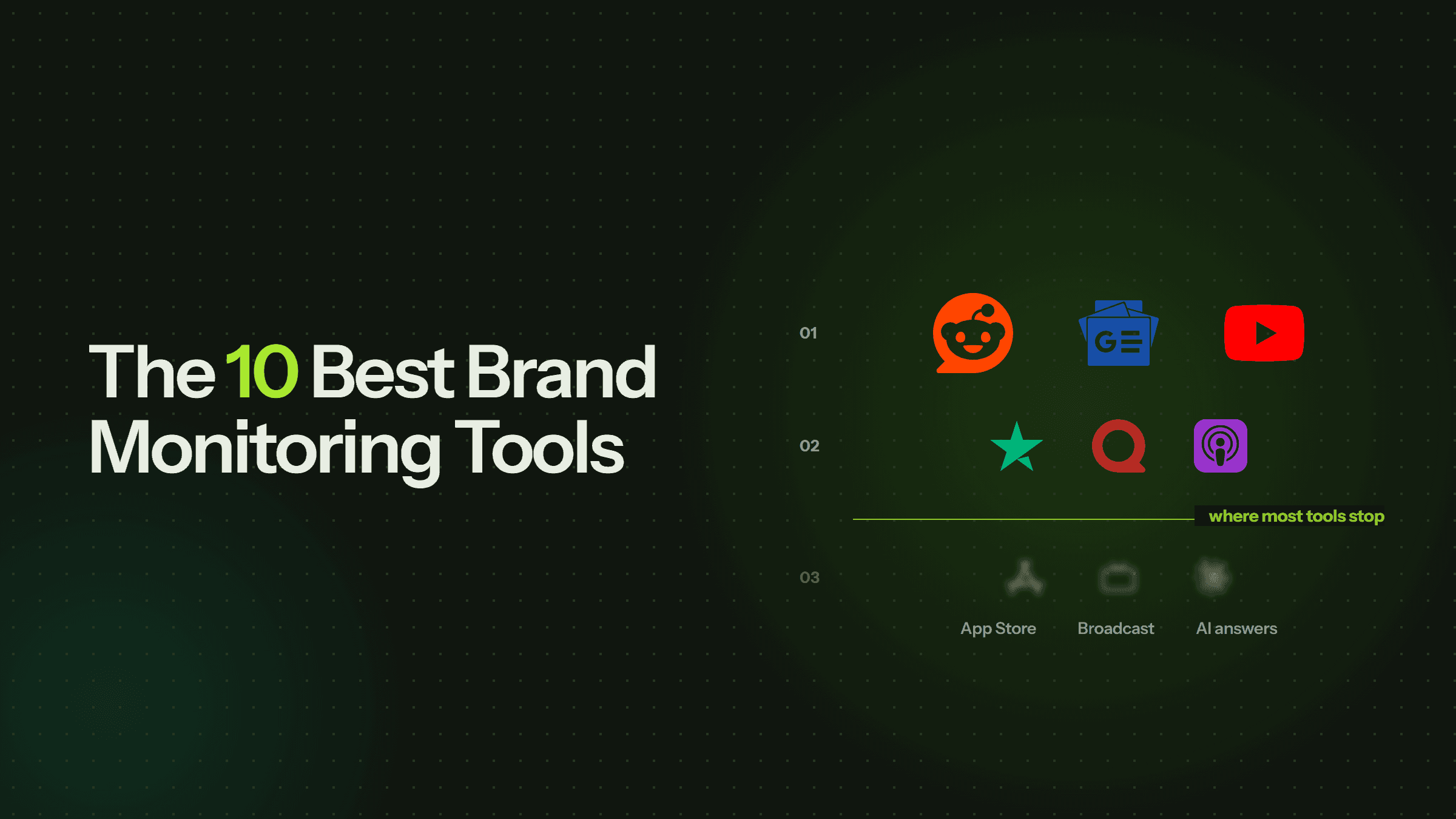
Eight of the ten tools below will find your brand on Reddit. One of them will find it on the App Store. One will find it on broadcast radio. Three will tell you what ChatGPT says about you when somebody asks it to recommend a product like yours.
Brand monitoring does not fail in the middle. Every tool here reads X, news and blogs perfectly well, and if that were the job you could pick on price and be done by lunchtime.
It fails at the edges. The mention that matters is almost always the one in the place your tool was never watching, and you find out it existed when a customer forwards it to you.
The worst version of it I have seen, in nine years of running marketing teams, was a one-star review thread on an app store that ran for five weeks while a perfectly good monitoring dashboard sat on a screen in our office reporting a quiet month. The dashboard was not broken. We had simply bought a tool that did not look there.
So this comparison is organised around one question: what does each of these tools actually name, and what is it quietly not watching?
Ours is in it, first, and it fails that test in two places. I name them before I name anybody else's.
Every price and every source list below came from the vendor's own site, read on 1 October 2026.
The ten, and what each admits to watching
Ten tools, and the places each one is prepared to put in writing. Click a tool to jump to its section.
| Tool | Best for | Pricing, as published | Free trial |
|---|---|---|---|
 BrandRobin BrandRobin | Seventeen named channels, with the analysis attached | Free for 7 days; paid plans coming soon | 7 days, no card |
 Brand24 Brand24 | The broadest named list, and AI answers at the top tier | From $199/mo billed annually, $249 monthly | 14 days, no card |
 Mentionlytics Mentionlytics | Review sites, with AI visibility as an add-on | From $69/mo billed yearly, $99 monthly | 14 days, no card |
 BrandMentions BrandMentions | Google Business Profile, app stores and booking sites | From $79/mo billed annually, $99 quarterly | 7 days |
 Mention Mention | Review coverage at a negotiated price | Not published, one Company plan | Yes, length not stated |
 Awario Awario | Mention volume on the smallest budget | From $29/mo billed annually, $49 monthly | 7 days, no card |
 BuzzSumo BuzzSumo | Press coverage and the journalists behind it | From $199/mo, $299 for PR and comms | Yes, length not stated |
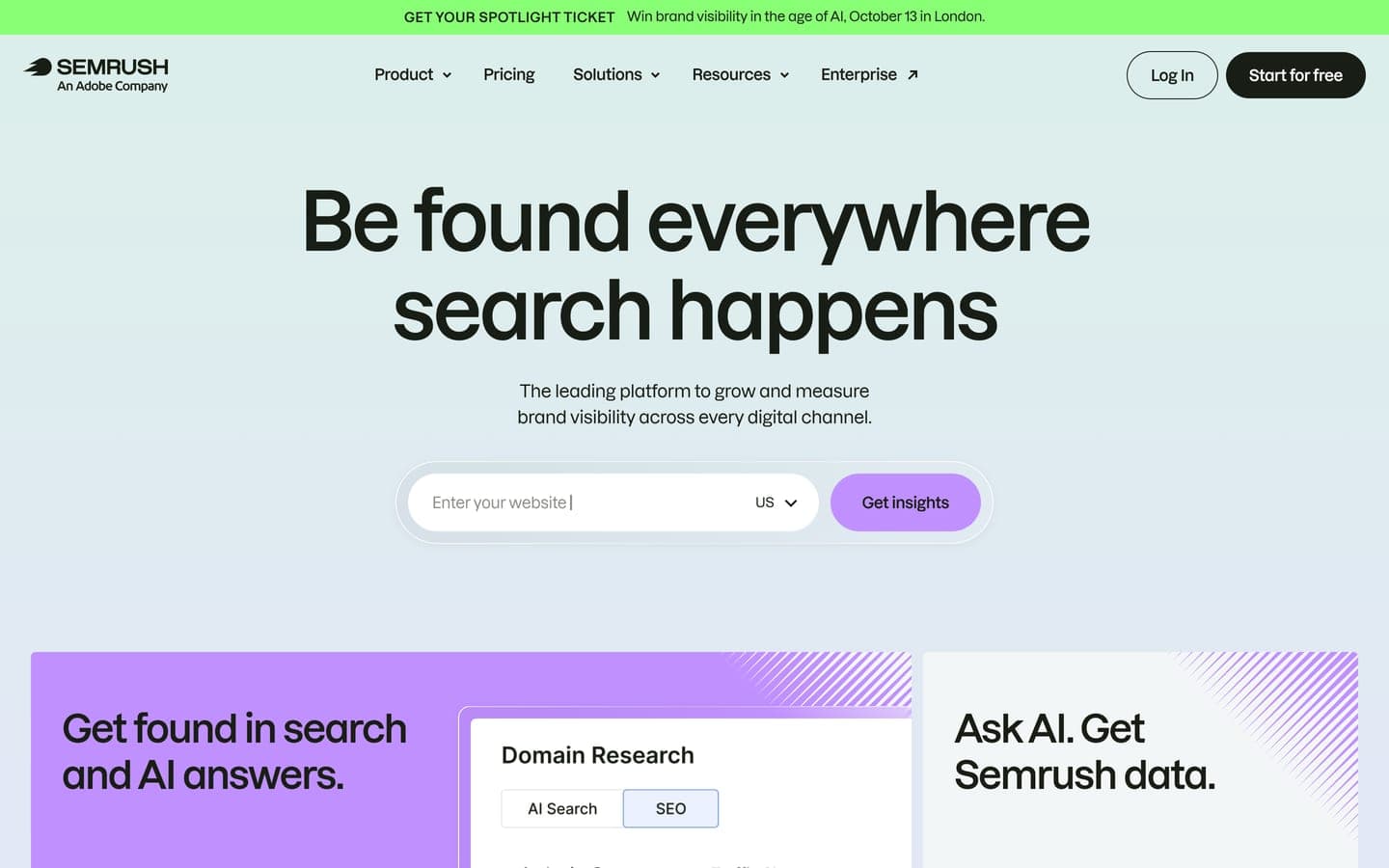
 Semrush Semrush | Unlinked mentions and AI search, inside an SEO subscription | Plans from $139/mo, $117.33 billed annually | Free trial offered |
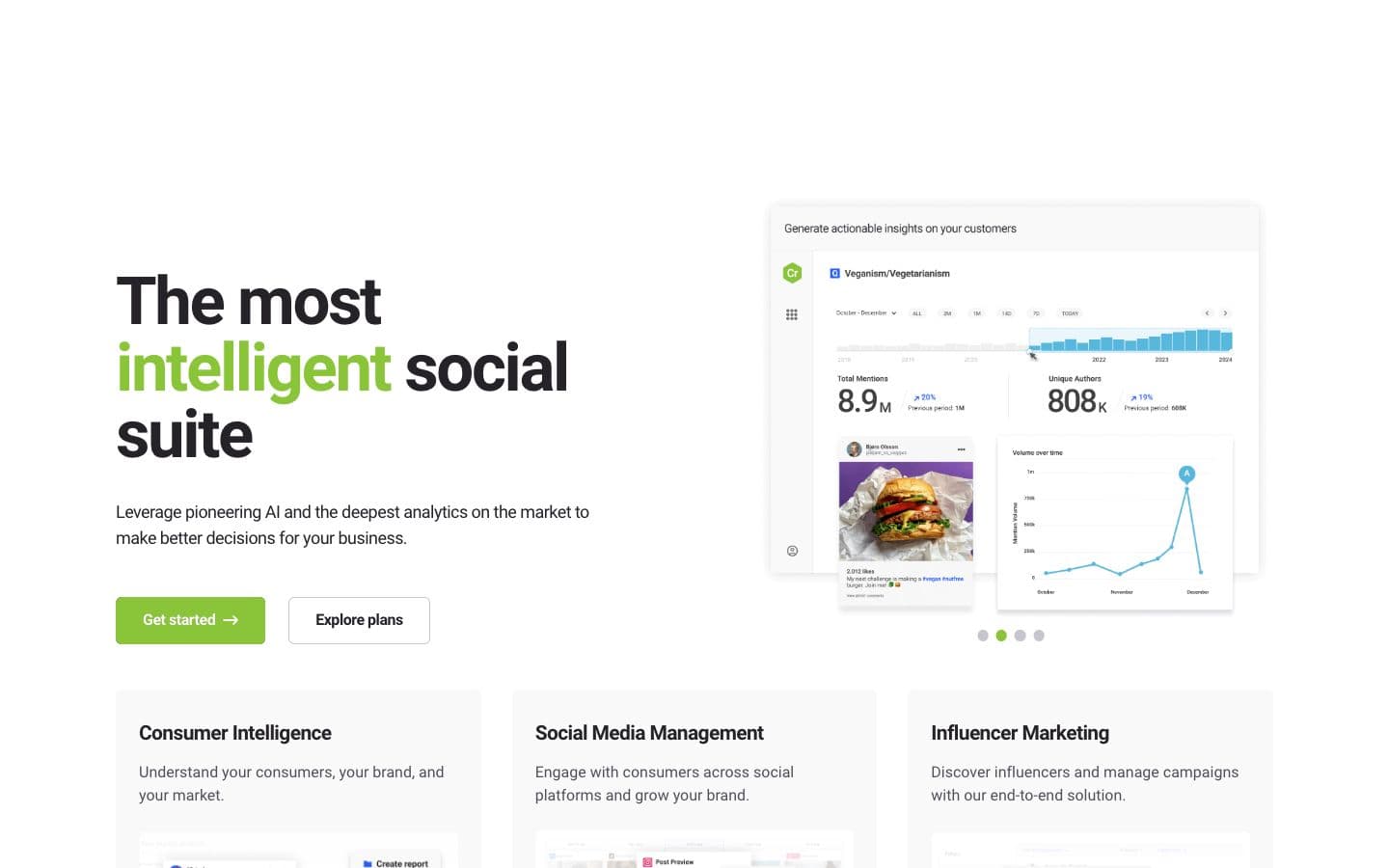
 Brandwatch Brandwatch | Depth, history and broadcast | Not published, demo only | No self-serve trial |
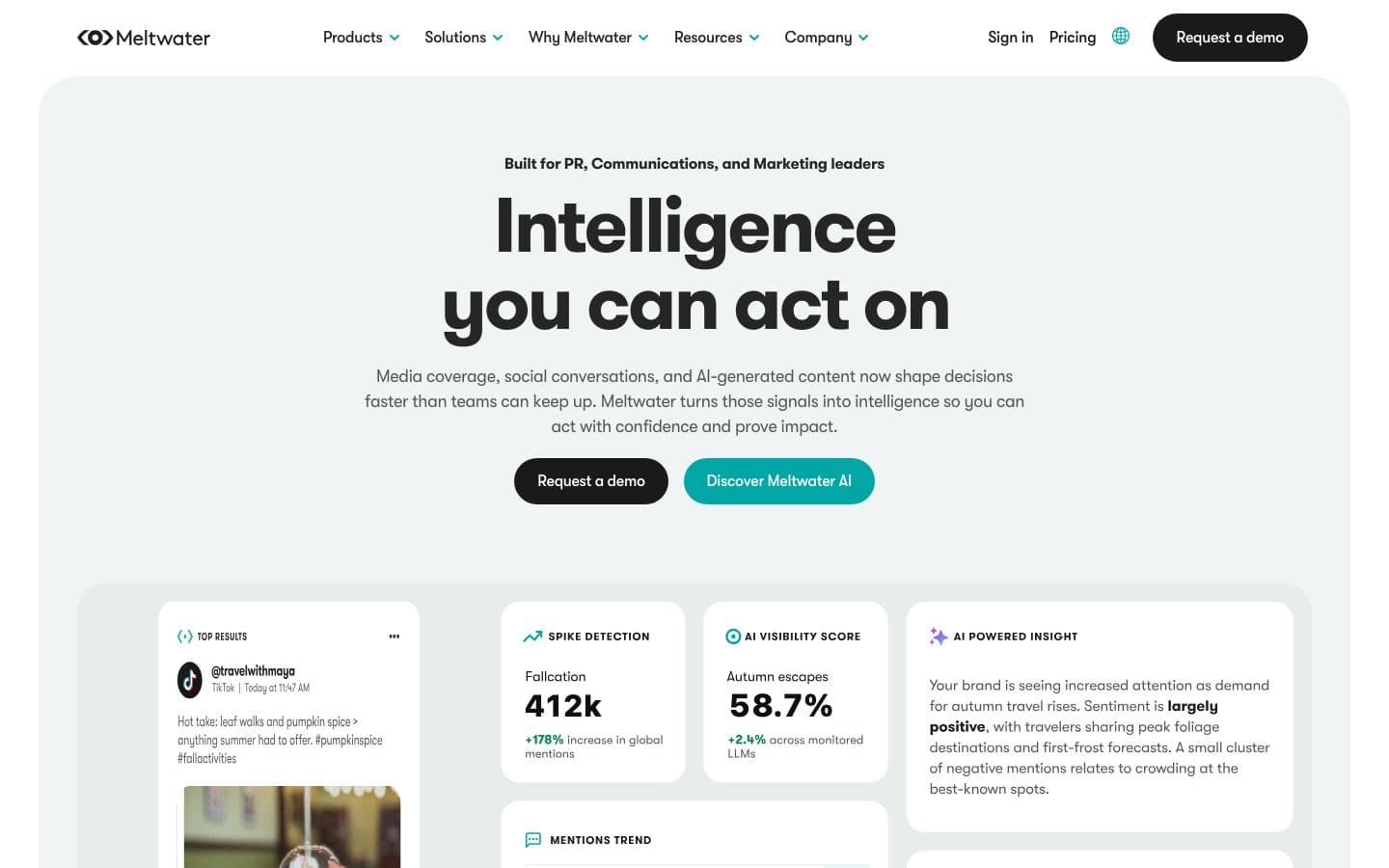
 Meltwater Meltwater | Paywalled press alongside social | Not published, 12-month minimum | No self-serve trial |
Where your brand actually gets mentioned
This is the table I wish somebody had put in front of me years ago. It is not about features. It is about which surfaces each of these companies is willing to name on its own website, because a source a vendor will not name is a source you should assume it does not cover.
| Where your name turns up | Who names it | Who does not |
|---|---|---|
| Reddit, forums and communities | BrandRobin, Brand24, Mentionlytics, BrandMentions, Mention, Awario, Brandwatch, Meltwater | BuzzSumo and Semrush, which are built around articles and search |
| Review sites | Mention lists 75+, Mentionlytics and Brand24 list reviews, BrandMentions names Yelp, Tripadvisor and Booking.com | Awario, BuzzSumo and Semrush name none |
| Google Business Profile and app stores | BrandMentions | Nobody else here names either one |
| Podcasts | BrandRobin, Brand24, Mention, Meltwater | The other six |
| Paywalled press | Meltwater | Everyone else, at any price |
| Broadcast TV and radio | Brandwatch | Everyone else, at any price |
| What AI assistants say about you | Brand24 on Enterprise, Mentionlytics as an add-on, Semrush inside its plans | The other seven, and that includes us |
| Private Slack, Discord and WhatsApp groups | Nobody | All ten of us, honestly |
Two rows in that table are worth more than the rest.
The last one is the honest limit of this whole category. A real share of what people say about your brand now happens in private communities, and none of these tools can see any of it. Anybody who tells you otherwise is selling something.
The AI row is the one that has changed since last year. People ask an assistant which tool to buy, and it answers with three names and a summary of what each one is like. That answer is now a brand surface, and it is one you cannot read by searching for yourself, because the answer differs by prompt and by model. Three of the ten watch it. Two of those three charge separately for it, and the third is an SEO subscription with it folded in.
What I held each one to
Five things, learned from buying these tools rather than from reading about them. They decided every pro and con below.
- A named list, not a number. "Millions of sources" is marketing. A list of places, written down, is a product decision somebody committed to. I only count what a vendor is willing to print.
- The places that are not social. Reviews, news, forums, app stores, booking sites, press. This is where brand monitoring differs from social monitoring, and it is where the gaps between these tools are widest.
- What the machines say. Your brand now gets described to buyers by systems that were not in anyone's media plan two years ago. Whether a tool watches that, and what it charges to, is a fair question in 2026 and an awkward one for most of this list.
- The caps, not the sticker price. Every tool here is sold on a headline price and limited by keywords and mentions. The entry tier of most of them runs out in a month for anything consumer-facing, so I price the tier above.
- Whether the mentions can leave. An API, an export, a webhook. A year of brand history that only exists inside a dashboard you are about to cancel is not an asset, it is a hostage.
If the words themselves are the confusing part, I wrote a plain explanation of what brand monitoring is and how it differs from listening.
Three different things get sold as brand monitoring
Three different products are sold under this phrase, and comparing across them is how teams end up disappointed by a tool that was never built for the job.
All-web monitors. BrandRobin, Brand24, Mentionlytics, BrandMentions, Mention and Awario. One job: find your name anywhere public and tell you. You can start most of them this week and cancel if they do not help.
Monitoring shaped like something else. BuzzSumo and Semrush. You are not really buying a monitor, you are buying a content tool or an SEO platform that happens to watch mentions. If you already pay for the parent product, this is the cheapest coverage you will ever add. If you do not, it is an expensive way to get a narrow slice.
Enterprise intelligence. Brandwatch and Meltwater. Depth, history, broadcast and licensed press, sold by a person, priced by negotiation.
You will notice the social media suites are not on this list. Sprout Social, Hootsuite and Agorapulse monitor the profiles you own very well and charge per seat to do it, and keyword monitoring past your own profiles is an add-on or an Enterprise plan on all three. I covered that purchase separately in the Sprout Social alternatives post.
Work out which of the three you are buying before you compare a single price.
BrandRobin
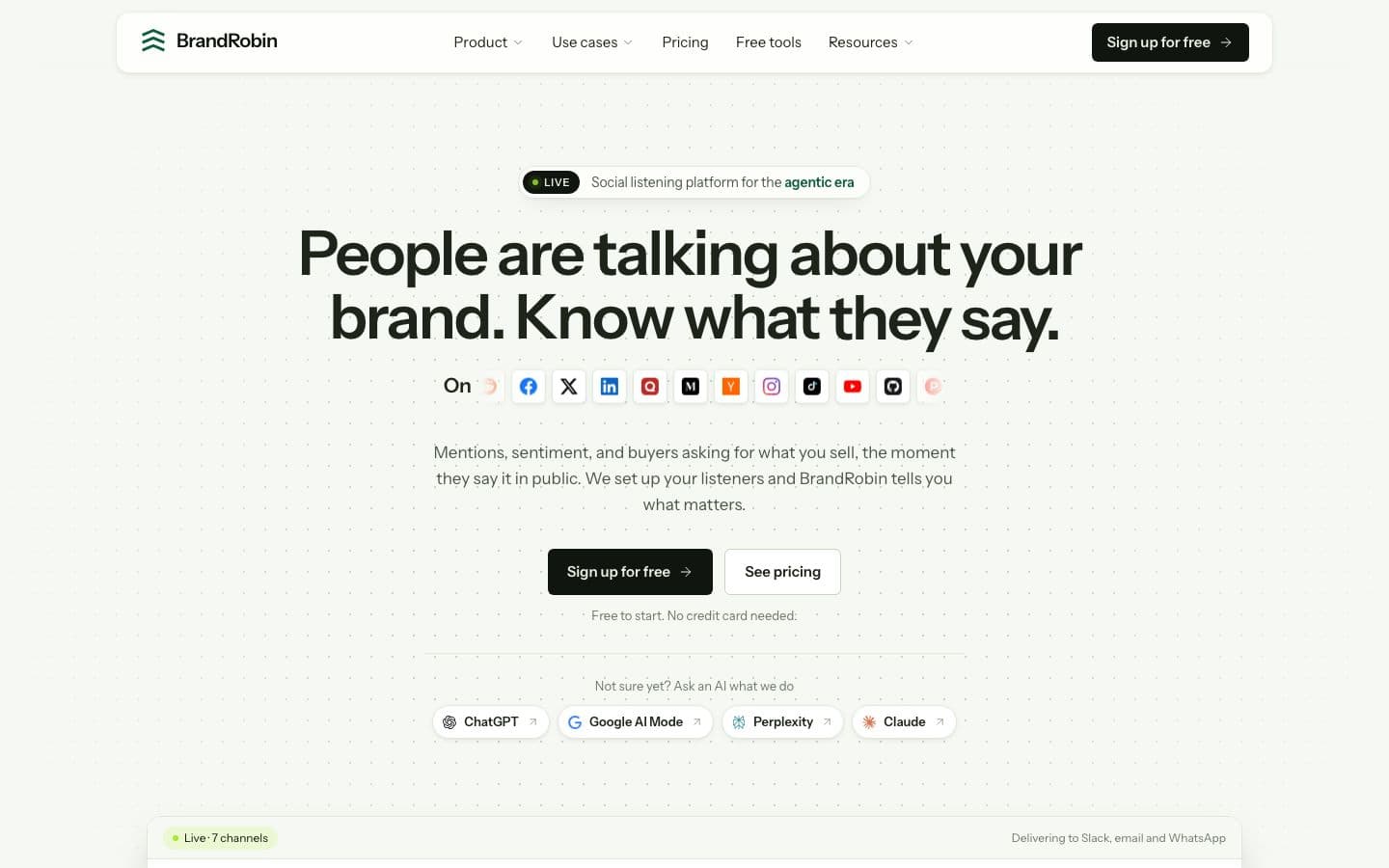
Ours, so discount it accordingly. The useful thing I can do here is name the places it does not reach, which is what this page does to the other nine. It fails the AI row of my own table.
Ours
- Best for
- Teams who want the public web covered and the mentions already analysed
- Starting price
- Free for 7 days. Paid plans are not priced yet
- Free trial
- 7 days, no card
Pros
- Seventeen named channels, including Reddit, X, LinkedIn, YouTube, Quora, reviews, news, blogs and podcasts. Named, so you can check them against your own five places.
- Two feeds rather than one, so the person shopping for something like yours is not filed behind the person who merely said your name.
- Ask it why something moved and it answers from your own mentions only, with the post behind every sentence linked.
- Paste a website and the last 30 days are backfilled the same day, so your first week of coverage is not a blank page.
Cons
- No monitoring of what AI assistants say about your brand, which is a real gap on this particular list.
- No licensed broadcast TV, radio or paywalled press, and no Google Business Profile or app store reviews.
- No published price yet, so the trial is the only number you can plan around.
- No API or MCP server yet, so nothing leaves the workspace on its own.
Where we stop: because most of these tools stop at finding the mention, and finding it is the easy half. BrandRobin is built for the part after, which is working out what the mentions mean and which of them is a person about to buy something. If your five places are on its list of seventeen, that is the argument. If one of them is an app store or a broadcast bulletin, buy the tool that watches it, and I would say the same to a friend.
Brand24
- Best for
- Teams who want the broadest named coverage without a sales call
- Starting price
- $199/mo billed annually ($249 monthly). Team $299, Pro $399, Business $599, Enterprise from $1,499
- Free trial
- 14 days, no card
Pros
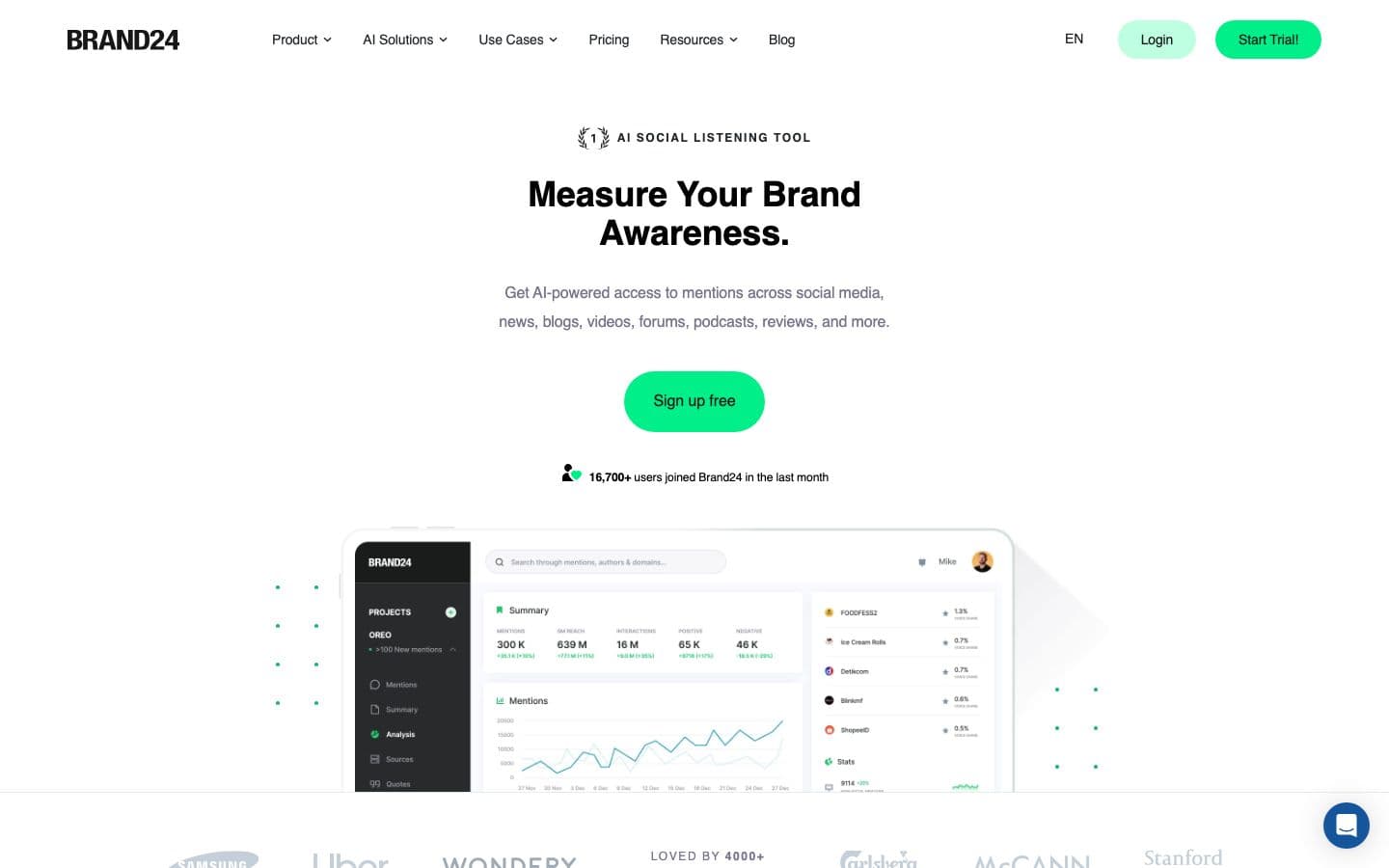
- The broadest named list you can buy self-serve: Facebook, Instagram, X, LinkedIn, TikTok, Reddit, YouTube, Twitch, news, blogs, reviews, Medium, Quora, newsletters and podcasts.
- An AI Visibility module that tracks how AI assistants describe and recommend your brand.
- Unlimited users from the Team plan up, and every tier priced in public.
- Sentiment is on every tier; AI insights, topic analysis and event detection arrive at Pro.
Cons
- The AI Visibility module sits on Enterprise, which starts at $1,499 a month.
- Individual buys 3 keywords and 2,000 mentions, one login, refreshed twice a day.
- G2 reviewers with common brand names say the keyword caps leave no room to exclude the noise.
Where it stops: on named coverage this is the tool to beat, and it is the only one here where the AI answers and everything else live under one login. Price that honestly, though. If AI visibility is the reason you are buying, Brand24 is a $1,499 a month product, not a $199 one, and the two tools below do that one job for a great deal less.
Mentionlytics
- Best for
- Brands where review sites and AI answers both matter
- Starting price
- Basic $69/mo billed yearly ($99 monthly). Essential $169, Advanced $299, Pro $499, Business $749
- Free trial
- 14 days, no card, nothing held back
Pros
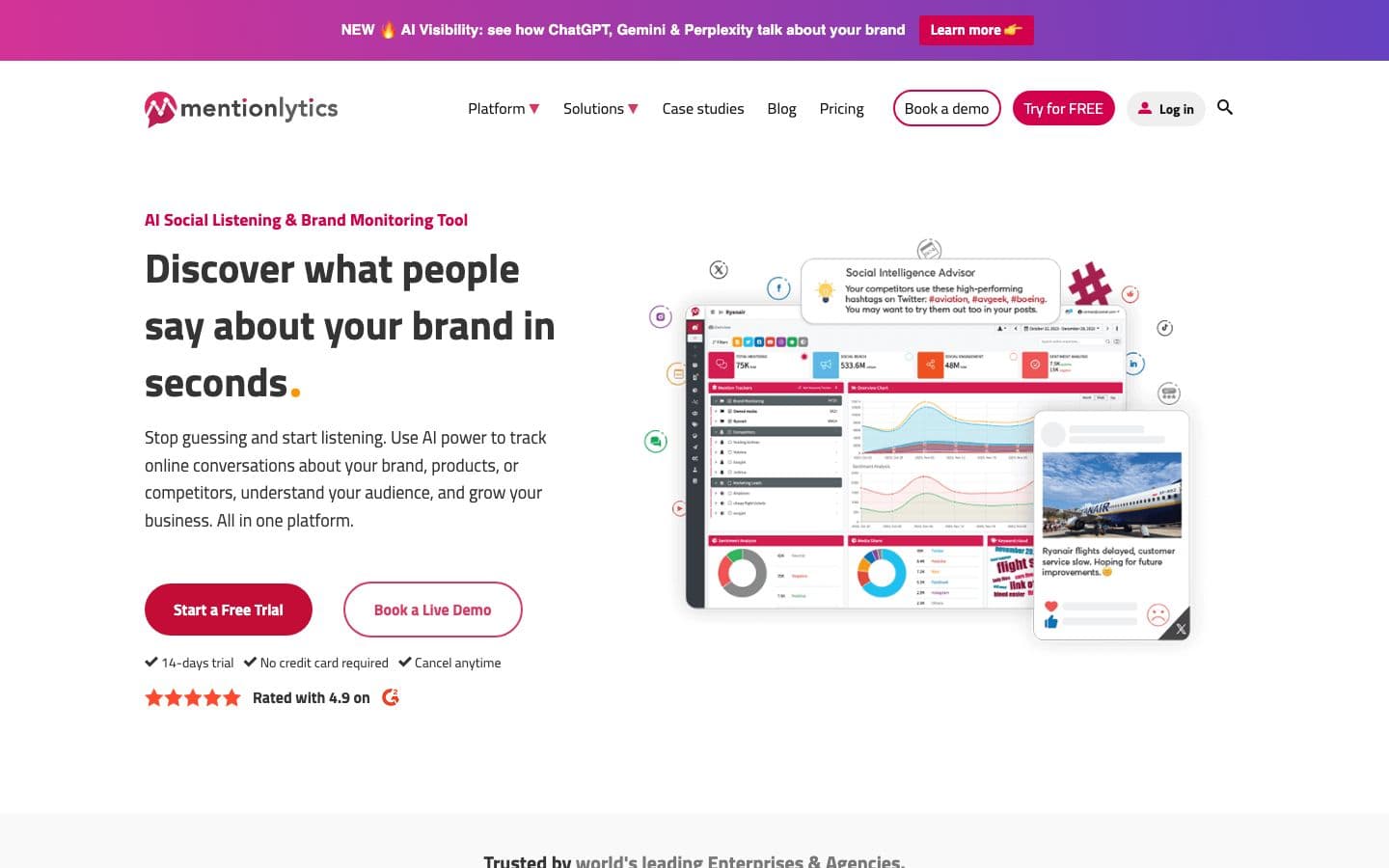
- Reviews sit beside X, TikTok, LinkedIn, Facebook, Instagram, YouTube, Reddit, Bluesky, Threads and the open web.
- An AI Visibility add-on available from the Essential tier, which is the cheapest route to that capability on this list bar one.
- A published price at every tier, and unlimited users from Advanced up.
- Nothing is held back in the trial, so what you test is what you would buy.
Cons
- Basic allows 3 keywords and 5,000 mentions, which a consumer brand burns through in weeks.
- AI visibility is an add-on, so the published tier price is not the price you pay for it.
- G2 reviewers hit the mention ceiling early, and say the sentiment reads sarcasm as praise.
Where it stops: the most complete coverage per dollar in the self-serve group, and the one I would shortlist first if reviews are a real part of your week. The product starts at Essential rather than Basic, so price the $169 plan and then ask what the AI add-on costs on top before you compare it with anything.
BrandMentions
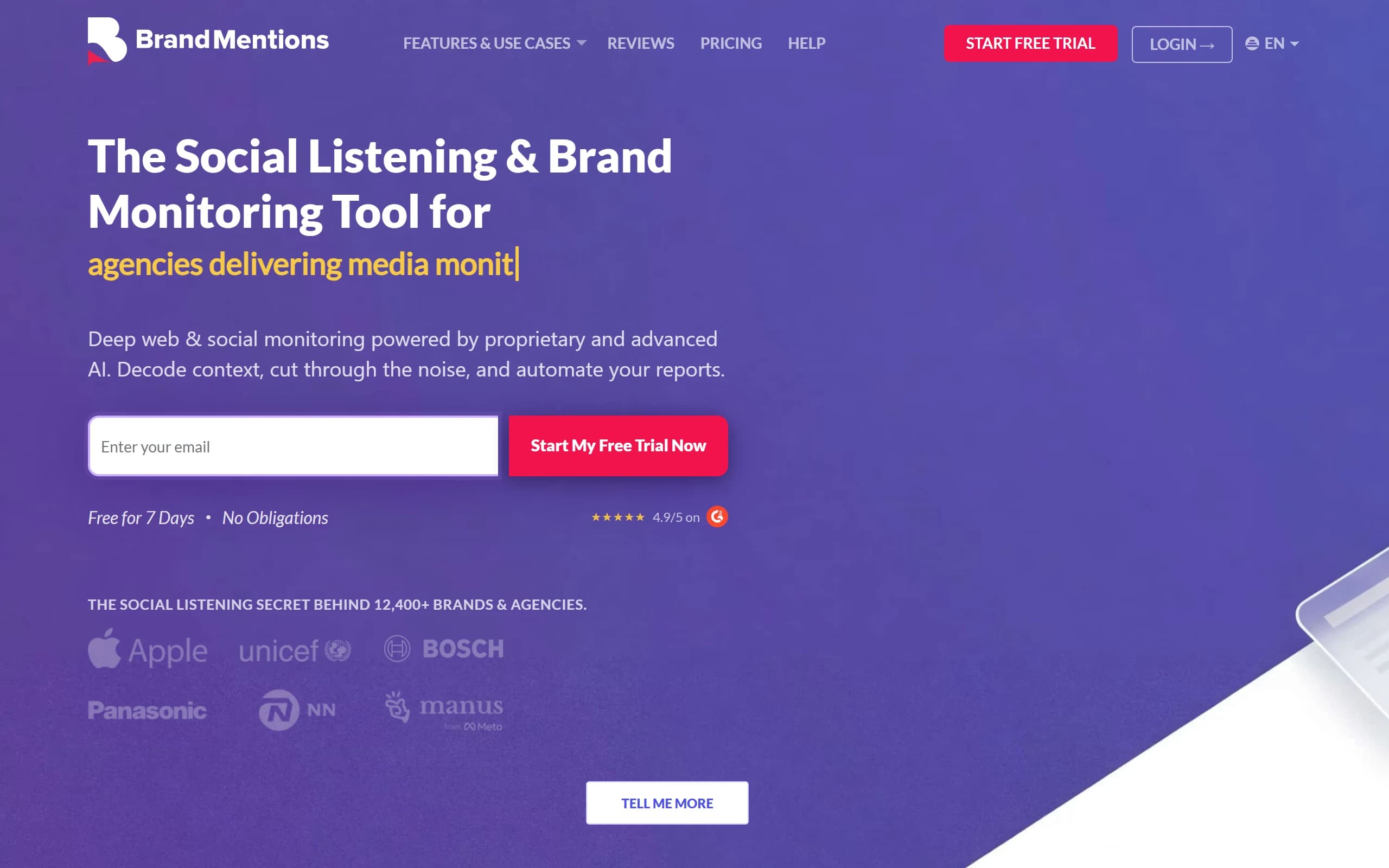
- Best for
- Businesses whose reviews live on Google, Yelp, Tripadvisor or an app store
- Starting price
- Starter $79/mo billed annually ($99 quarterly). Pro $249 annually, Expert $399 annually, Enterprise from $1,099
- Free trial
- 7 days
Pros
- The only tool here that names Google Business Profile, the App Store and booking sites such as Booking.com and Tripadvisor among its sources.
- 5 keywords and 5,000 mentions on the entry plan, where most rivals give you 3 keywords.
- Real-time updates and Boolean search on the Expert tier.
- A 7-day trial you can start without a sales call.
Cons
- No API below Expert at $399 a month, so the cheaper plans are a dashboard you cannot get data out of.
- Starter and Pro both update daily, which is slow if you need to catch a complaint on the day it lands.
- Two users on Pro at $249 a month is tight for a team.
Where it stops: if you are a hotel, a restaurant group, a clinic or an app, this is the row of the coverage table that decides your purchase, and BrandMentions is holding it alone. Everyone else on this page will miss the review that actually costs you bookings. Just go in knowing the data does not leave the building until $399.
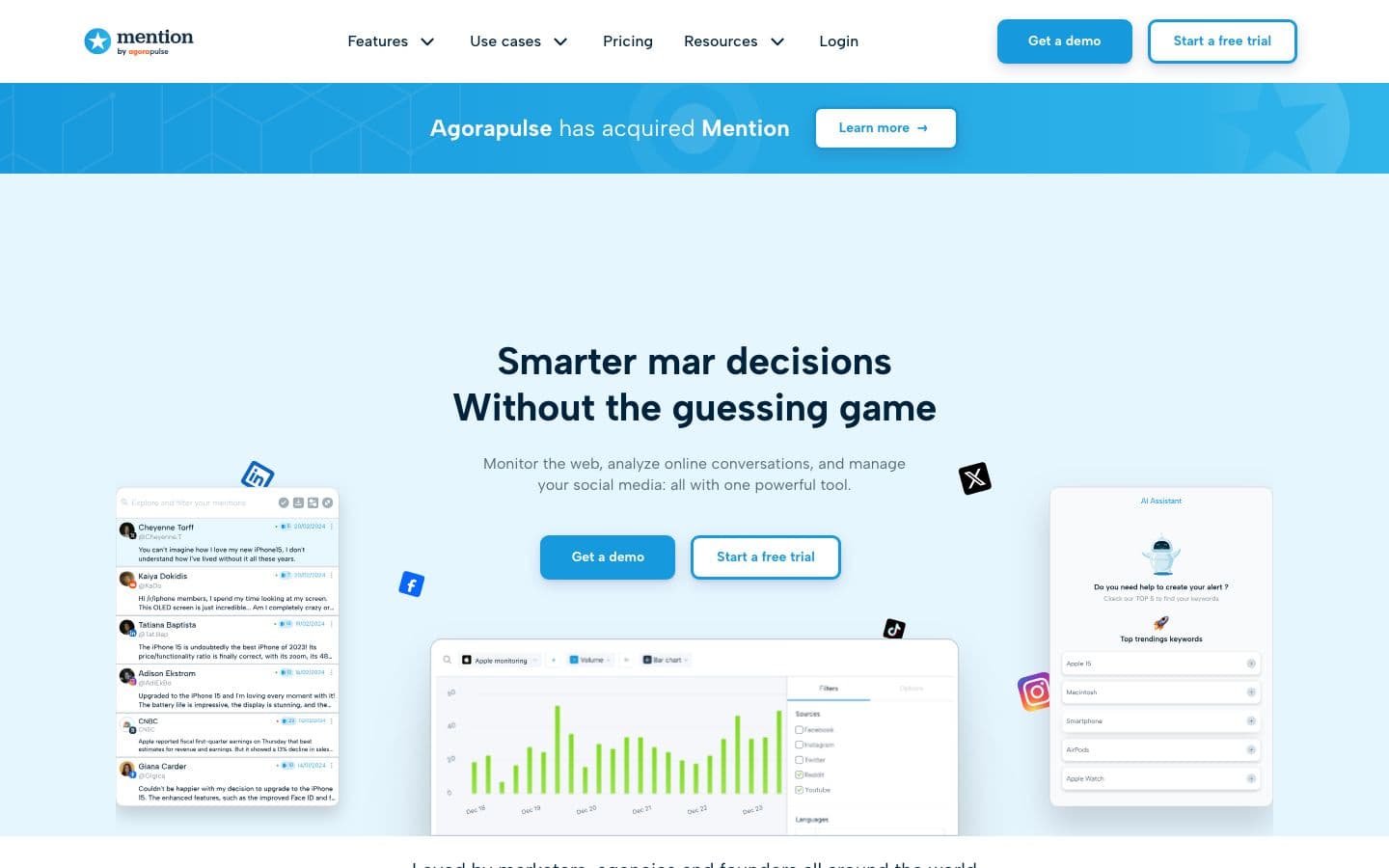
Mention
- Best for
- Brands with a procurement process and a review problem
- Starting price
- Not published. A single Company plan, quoted on request
- Free trial
- Yes, length not stated
Pros
- Over 75 review sites named, including Google, Trustpilot, Amazon and Glassdoor, alongside Facebook, Instagram, X, Reddit, TikTok, Pinterest, YouTube, news, blogs, forums and podcasts.
- API access listed as part of the plan rather than an extra.
- Boolean queries, share of voice, and competitors tracked side by side.
Cons
- No public price. The pricing page shows a Company plan with the number missing and a yearly saving quoted against it.
- LinkedIn is not among its named sources.
- G2 reviewers describe a setup that takes real work before the feed is worth reading.
Where it stops: the review coverage is genuinely strong and the named list is one of the longest here. The problem is that you cannot compare it to anything until somebody quotes you, and by then you have spent the afternoon. Go into that call knowing what Mentionlytics and BrandMentions would have cost you for a similar job.
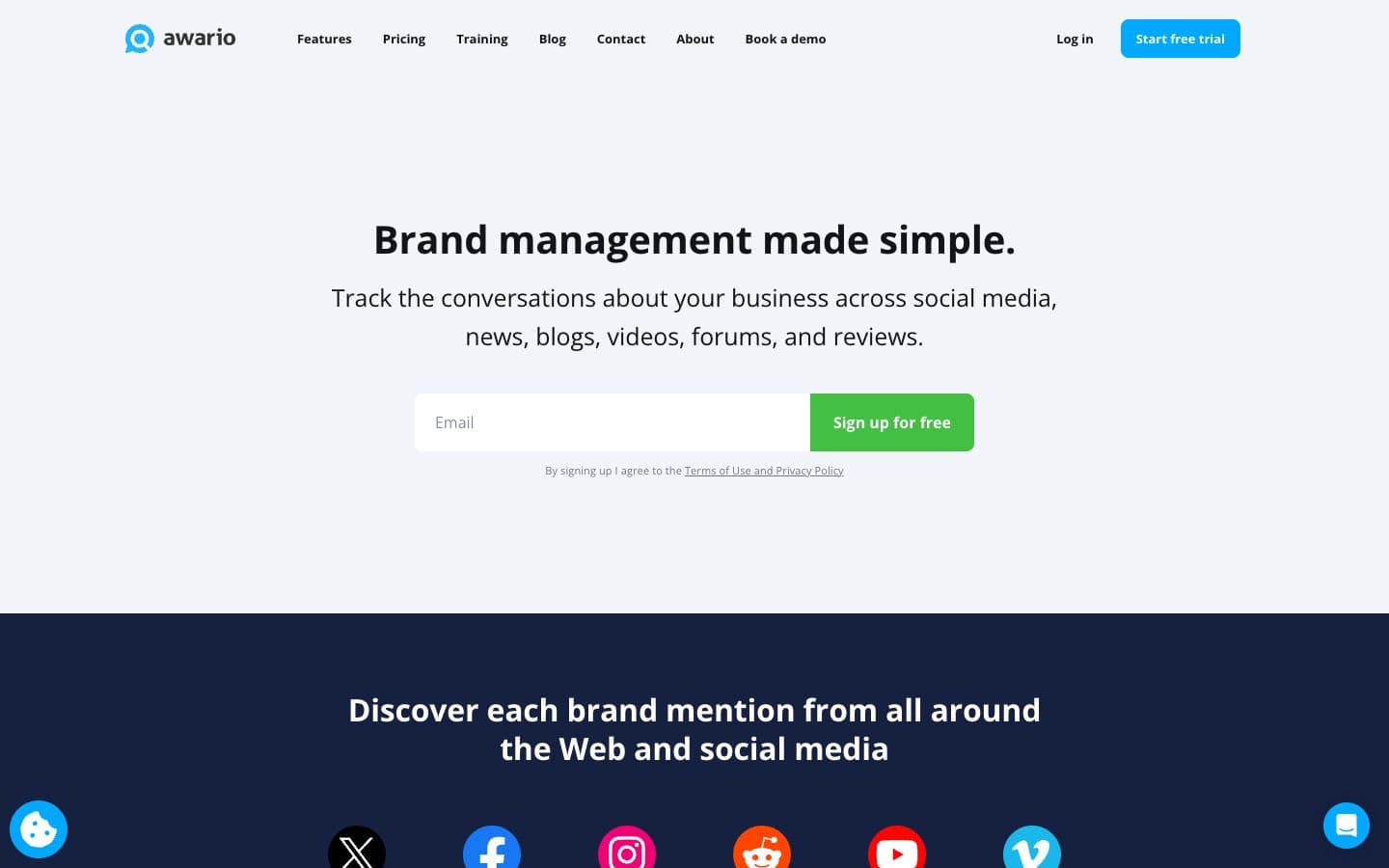
Awario
- Best for
- Small teams buying volume rather than coverage
- Starting price
- $29/mo billed annually ($49 monthly) for 3 topics and 30,000 mentions
- Free trial
- 7 days, no card
Pros
- Thirty thousand mentions a month at $29 is the most volume per dollar on this page.
- Boolean search and API access listed across the plans.
- Unlimited keywords inside each topic.
Cons
- The named sources are Reddit, Instagram, X, Facebook, YouTube, Vimeo and news. No review sites, no TikTok, no LinkedIn.
- One seat on Starter.
- G2 reviewers report both halves of the accuracy problem: noise nobody asked for, and mentions that never arrived.
Where it stops: the clearest example on this page of why volume is the wrong thing to shop for. Thirty thousand mentions is a lot of mentions from seven places, and brand monitoring is a question about the eighth. If your customers are on Reddit and in the news, this is an excellent $29. If they review you anywhere, it is not a brand monitoring tool at all.
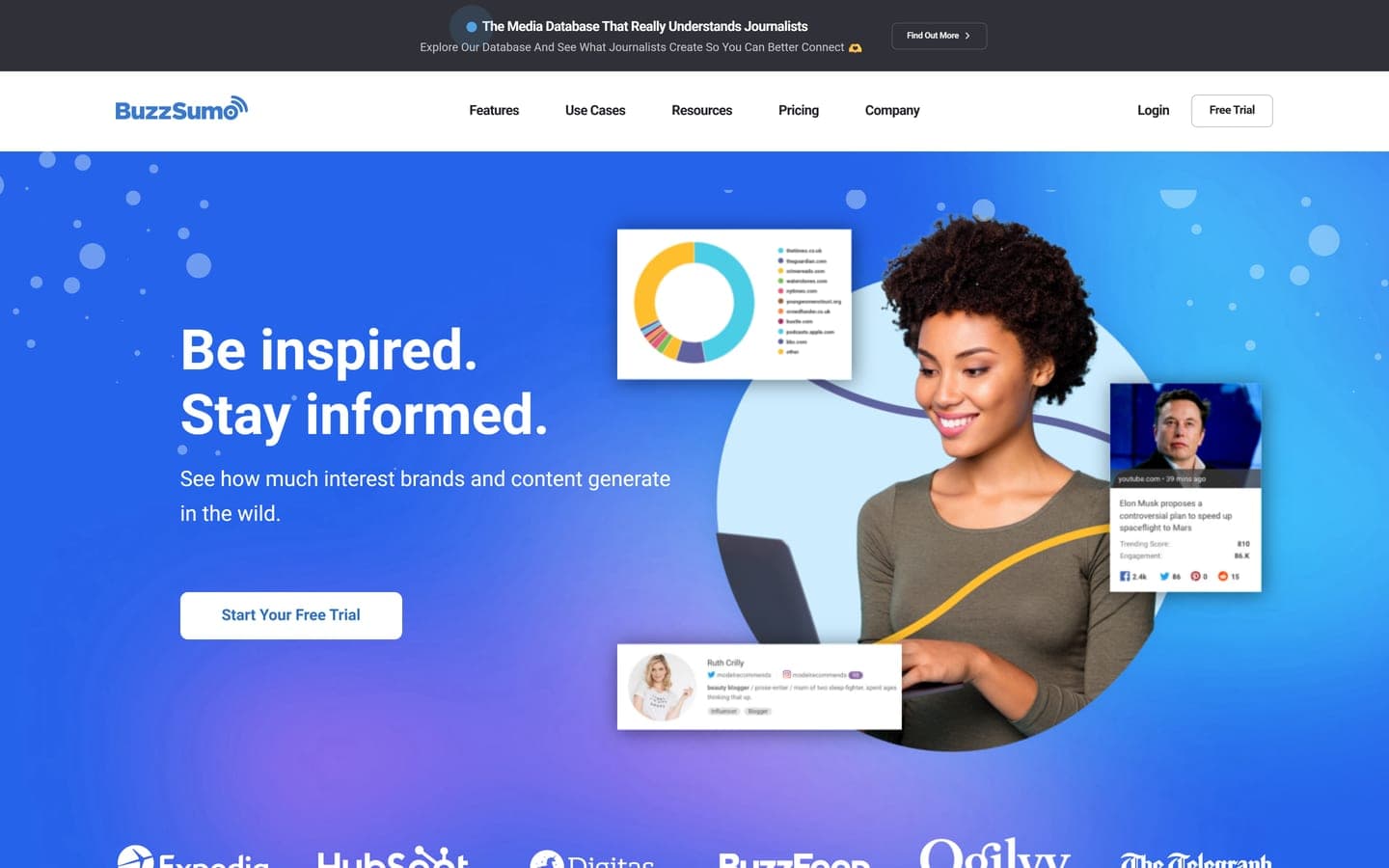
BuzzSumo
- Best for
- PR teams who care who wrote about them, not just that somebody did
- Starting price
- Content Creation $199/mo, PR and Comms $299, Suite $499, Enterprise $999
- Free trial
- Yes, length not stated
Pros
- A journalist and media database, so a mention comes with the person behind it and a way to follow up.
- Coverage reports and a Slack integration from the PR and Comms plan.
- Unlimited searches and exports on every plan, with two to five years of historical content.
- Ties a mention to how the article actually performed, which no pure monitor on this list does.
Cons
- Two alerts on the $199 plan and five on the $299 one. As a monitor, that is a very small number of things to watch.
- Built around articles, so Reddit, forums and review sites are not what it is for.
- Owned by Brandwatch, and priced like a product that expects you to want the content tooling too.
Where it stops: judged as a brand monitor it is narrow and expensive. Judged as the thing it actually is, which is press intelligence with monitoring attached, it is the best tool here for a comms team that needs to know which journalist to email back. Buy it for that, and pair it with something that watches the rest of the web.
Semrush
- Best for
- SEO-led teams who want unlinked mentions and AI answers in a tool they already pay for
- Starting price
- SEO $139/mo ($117.33 billed annually), Starter $199, Pro+ $299, Advanced $549
- Free trial
- Free trial offered
Pros
- AI search tracking and AI sentiment are included in the plans rather than sold as a separate module.
- Finds unlinked mentions, which is a brand monitoring job that doubles as link building and no other tool here frames that way.
- Published prices at every tier, and an annual discount that is actually a discount.
- If your team already has a seat, the marginal cost of this coverage is close to nothing.
Cons
- Brand Monitoring is an App Center app, and I could not find its own price published anywhere I could read.
- No Reddit, forum or review-site monitoring in the way the dedicated tools mean it.
- Only worth it on top of an existing Semrush subscription; as a standalone monitor it is the wrong shape.
- Now an Adobe company, so expect the packaging to move.
Where it stops: the cheapest honest answer to the AI question on this page, as long as you were buying Semrush anyway. What it will not do is tell you about the Reddit thread, and the gap between an SEO tool's idea of a mention and a monitoring tool's idea of one is wider than the demo makes it look.
Brandwatch
- Best for
- Large brands who need depth, history and broadcast
- Starting price
- Not published. Standard through enterprise, all behind a demo
- Free trial
- No self-serve trial, demo only
Pros
- The only tool here with broadcast TV and radio, which is unbuyable at the other nine.
- Social archives reaching back to 2008, and news, blogs and forums to 2010.
- One of the widest network lists anywhere, including Reddit, Twitch, WeChat, Weibo and reviews.
- Finds your logo inside images, and will train classifiers on categories you define.
Cons
- Nothing published anywhere, so the first number you see comes from a salesperson.
- No self-serve trial.
- G2 reviewers warn that writing a good query is a skill, and that new users rarely arrive with it.
Where it stops: if a television segment about your category would matter to your board, this is a one-vendor row and the conversation starts here. If it would not, you are paying for a research library to read this week's mentions.
Meltwater
- Best for
- Comms teams whose worst week is a press story, not a post
- Starting price
- Not published. Four packages, annual only, twelve-month minimum
- Free trial
- No self-serve trial, guided demo
Pros
- Paywalled news in the same contract as social, which nobody self-serve can license.
- Press archives to 2009, with a rolling fifteen months of social beside them.
- Spikes land in Slack or Teams, and its assistant cites what it read.
- Support for over 240 languages.
Cons
- No number anywhere, and a twelve-month minimum stated on the page.
- No self-serve trial.
- G2 reviewers describe the better features living one tier up, and access ending abruptly when a contract does.
Where it stops: the other one-vendor row. If the coverage you worry about sits behind a paywall, this is the contract, and the twelve months is the price of the licence rather than a sales tactic. If it does not, twelve months is a long time to pay for a capability you will not open.
Who I would point at what
| If your blind spot is… | Shortlist | Why |
|---|---|---|
| The analysis, not the finding | BrandRobin | Seventeen named channels with buyer signals split out and sourced answers |
| Breadth, in one self-serve tool | Brand24 | The longest named list with every price published |
| Reviews, at a sensible price | Mentionlytics | Review coverage from a $169 tier, with AI visibility available on top |
| Google, Yelp, Tripadvisor or an app store | BrandMentions | The only one here that names them |
| What AI assistants tell buyers about you | Semrush, Mentionlytics | Included in a $139 plan, or an add-on, rather than $1,499 a month |
| Which journalist wrote it | BuzzSumo | A media database and coverage reports attached to the mention |
| Mentions per dollar, nothing fancy | Awario | 30,000 a month at $29 billed annually, from seven named sources |
| Broadcast, or press behind a paywall | Brandwatch, Meltwater | One vendor each, and no substitute at any budget |
How to find your own blind spot in an afternoon
This is the exercise I wish we had run before buying, instead of after. It costs nothing and it eliminates most of a shortlist before any trial begins.
- 01
Write down the five places you were actually mentioned this year
Not the places you post. The places it happened to you: a review, a forum thread, a podcast, a local paper, a comparison article someone sent you in Slack. Five real examples, with links where you still have them.
- 02
Check those five against each vendor's own source list
Before a single trial. If a vendor does not name the place in writing, treat it as uncovered and move on. This usually removes half the shortlist in twenty minutes, and it is the cheapest filtering you will ever do.
- 03
Run the survivors on a mention you already know about
Start the trials on the same day, on the same brand, and check whether each one found the thread you picked in step one, and how long it took. A tool that misses a mention you handed it is telling you something.
- 04
Ask what happens to the mentions when you leave
Is there an API, an export, and does access survive the last day of the contract? A year of brand history trapped inside a tool you are cancelling is a cost nobody puts on the quote.
One more thing worth doing while you are there: ask two or three AI assistants to recommend a product like yours and read what they say about you. It takes ten minutes, you do not need a tool for it, and it will tell you whether the expensive AI visibility row of that coverage table is a real problem for you or a hypothetical one.
If speed is what you are really buying, I ranked the social media monitoring tools on how fast the alert arrives and where it lands. If you want the analytical half of this category instead, the best social listening tools covers it, and what social listening costs has the budget maths.
Where I would start
Brand monitoring is a coverage question wearing a feature list. Almost every tool on this page will do a competent job of the places you already know about, and the one you should buy is the one that covers the place you keep being surprised by.
So do the cheap thing first. Write down your five places, hold each vendor's own source list against them, and let that kill the shortlist before any demo does. Then see what the conversations about your brand look like when something is actually watching them. The right tool is not the one with the longest list. It is the one whose list has your five on it.
Keep reading
Competitor Intelligence
10 Sprout Social Alternatives, and What Each One Actually Costs
Read itSocial Listening
The 10 Best Social Media Monitoring Tools in 2026
Three of these ten publish how often they actually check for new mentions, and on the entry plan it is every twelve hours. Ten monitoring tools judged on the two numbers that decide the purchase: how fast the alert arrives, and where it lands.
Read itSocial Listening
Best social listening tools in 2026 (Tried & tested)
Read it